
HR, payroll and attendance software for sugar mills in Pakistan
A sugar mill is a seasonal factory, not a farm and not a year-round assembly line. During the crush the gate, the cane yard, the weighbridge and the mill house run around the clock. When the season ends, most of that crew leaves and the workshop stays. StreamHCM keeps attendance, shifts, leave and payroll for the people the mill pays, in one cloud account. EOBI is federal. PESSI or SESSI follows the province of the mill.
What a sugar-mill HR team switches on first
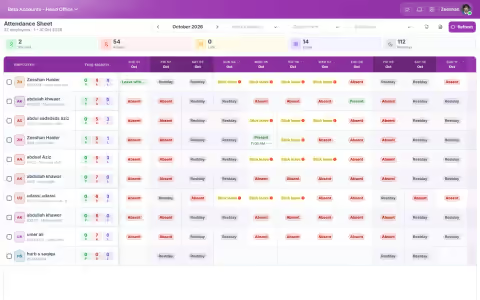
The first cane truck does not require every module. Pay the people on this season's list, take the punch at the gate the mill really uses, and issue the slip. A weighbridge clerk and a seasonal loader should not be pushed through the head-office timetable.
Mill-house crews clock on a fingerprint or a face camera. Cane-yard loaders and weighbridge clerks can use a second reader, because their hours are not that rotation.
Crush weeks need fixed, rotating and night patterns. A shift may pass midnight and still count as one day. Extra hours stay pending until a supervisor accepts them.
One period can hold a monthly salary, a daily-wage figure and an allowance you type, such as housing or a colony line.
Seasonal names can arrive together when crushing opens, and the same attendance closes their settlement when the contract stops.
If the mill assigns a safety course, keep it on the person rather than in a sheet that sits next to the wage.
Each mill can be its own branch: its readers, its holidays and its statute, so a Punjab mill is not paid on a Sindh slip.
The mill compound is not the farm
A sugar mill's payroll is the people the mill itself employs. The cane yard, the weighbridge, the mill house, the boiling house, the power house, the workshop and the colony are different clocks inside one compound. The grower, the grower's hired labour and the field around the mill are a different employer. That chain, including ginning, dairy collection and the crop calendar, is agriculture HR software. The agriculture page is where the Punjab laws text of the cane-grower definition is set out. The grower definition stays on the agriculture page. A grower's crew does not belong in the mill's workbook just because the cane is the same.
A year-round plant that is not a sugar mill, whether packaging, engineering or auto parts, is manufacturing HR software. A cement kiln that runs through the night, on a site that is not this mill, is cement plant HR software. A rice mill, a flour mill, a dairy plant or a bottling line, once the work is inside that plant, is food and beverage HR software. A truck that has left the mill yard, as a logistics workforce, is HR software for logistics. The sugar page is the case where the product is sugar, the busy months are the crush, and the workforce swells and then leaves.
The Sugar Factories Control Act, 1950, as published on the Punjab laws site, defines the crushing season as the period beginning on 1 October and ending on 30 June next. Section 8 says the occupier starts crushing not later than a date the Government specifies, which shall not be later than 30 November. Use the date the Government has specified for the year you are crushing. The date you run is that date. The same text's definition of a factory, premises where twenty or more workers are working, or were working on any day of the preceding twelve months, and where sugar is produced by vacuum pans with the aid of power, is a scope test in the Act. It is not a census of mills and not a wage. A Sindh mill follows the Sindh instrument. The Sindh text stays with that instrument. The HR software Pakistan page is the product overview. The mill version is the crush, the gate and the season.
Opening the crush and closing the contracts
Joiners do not arrive in twelve even slices. When cane starts, HR brings on a seasonal and contract crew, puts them on shifts, pays them for the campaign, and separates them when it stops. A workbook only the timekeeper can read is how one name is paid twice, or how a night the gate already stored never reaches the wage. Seasonal people sit on the same employee record as the all-year staff. An employment type keeps a season apart from a permanent contract. You can add a joiner on the employee list without waiting for recruitment, and you can import a batch with the CNIC, the shift and the dates already in your file.
At the close of the season, settlement should read the attendance the wages already used: days worked, overtime that was approved, leave if your policy pays the balance, and loans or advances that are still open. Standing-order gratuity, and where a province has replaced it, is the gratuity and final settlement guide. Check the current gratuity terms with your adviser or the gratuity guide. Who qualifies is a legal question, not a product setting. Compare a draft with the final settlement calculator. Inside the product, settlement is marked on Enterprise. Check pricing before you tell a mill that a smaller plan already has that tool. The file remains, so next season's rehire is an update rather than a new spreadsheet.
Yards and short campaigns often use contract labour. Whether someone employed through another person counts for EOBI is the point the manufacturing HR software page draws from section 1(4) of the EOBI Act 1976. The section is not copied here. If the contractor's crew and the mill's own crew have different employers, different attendance and a different wage, they should not share one workbook and one rule set. An employment type lets those rules differ, on the record of whichever employer actually pays the person.
Round-the-clock shifts and the overtime they create
Crushing week is not an office day. Mill house, boiling house and power house can each run past midnight. A system that starts a new day at midnight will treat the second half as a missed punch and the wage will be short. Fixed, rotational, split and night shifts are in the shift module, with templates and bulk assignment by branch. The list is on shift scheduling and the shift module. How to enter one is how to set up a shift. After the season, maintenance and a smaller power-house crew need their own template. They should not keep the crush's three-shift pattern by mistake.
Extra hours ought to come from punches a supervisor has accepted, not from a figure typed after the cane is already milled. Overtime is calculated from attendance and can be held for that approval. You choose the multiplier. There is no single national overtime formula. Factories and commercial establishments can have different hour limits, and provinces have amended the shops laws in different ways. A sugar mill is often a factory. Lock a rule only after overtime rules in Pakistan, and try a month in the overtime calculator. Double time is the calculator's default. It is a model, not a statutory rate for every mill. Asking for overtime in the employee app is listed on Enterprise at pricing. Defining the shift itself belongs with attendance, which starts on Starter.
If the mill pays a night allowance, that line is not overtime. The shift page treats a night or shift allowance as company policy or the contract, unless a statute you rely on says otherwise. No statutory night rate is stated, and no crushing-season bonus is stated either. Attach the allowance to the shift, or type the approved amount for the period. The slip can show it alone, which is the figure someone will set beside the register.
The mill gate, the cane yard and the weighbridge
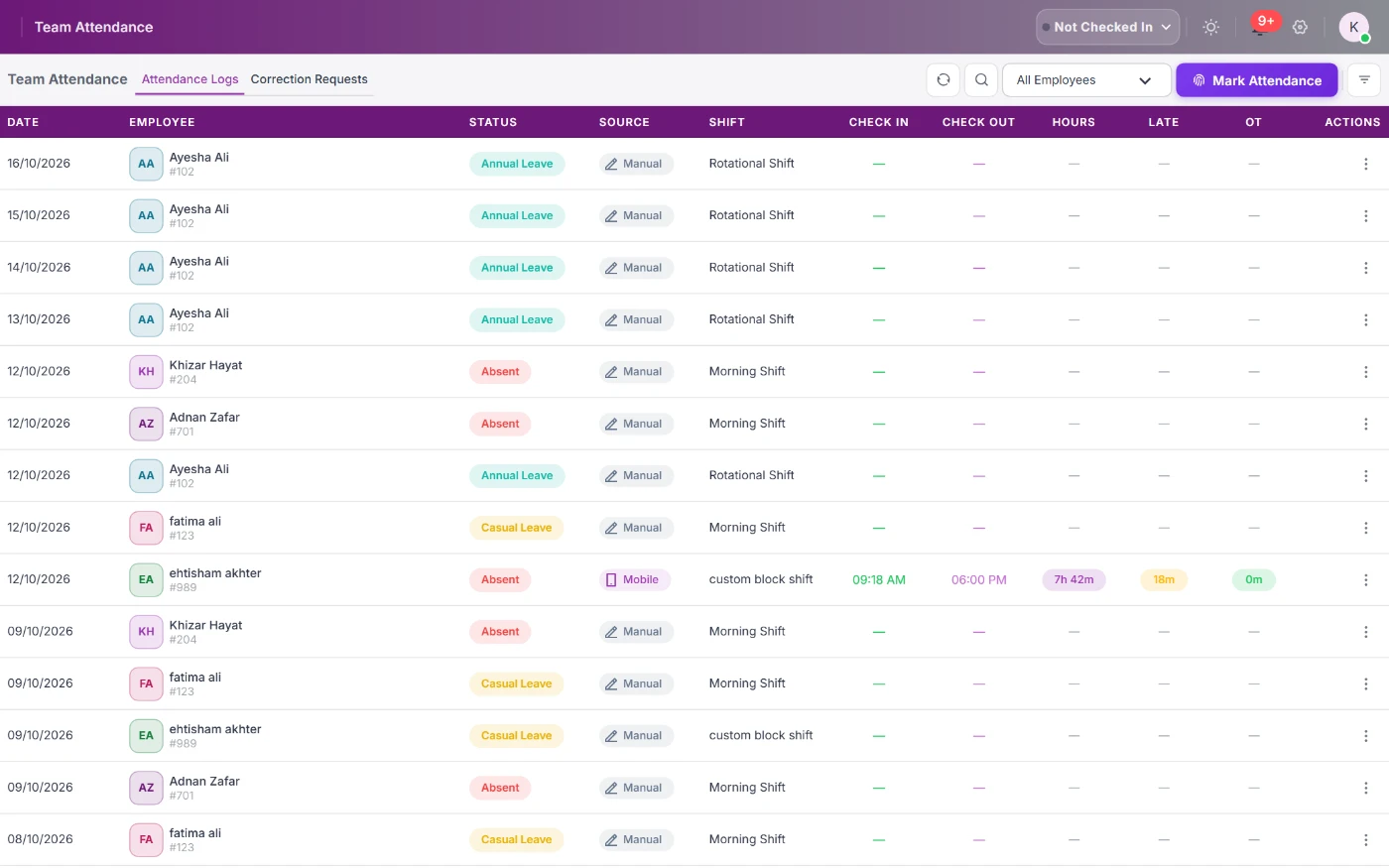
Shift change at a crushing gate is a crowd. Fingerprint or face is how that crowd becomes the right person on the right shift before pay is read. Face recognition and biometric attendance are marked on Enterprise. Devices, including ZKTeco, are on biometric attendance. How a punch becomes part of the wage is ZKTeco payroll integration. Grace, a late mark and a missed punch are attendance management. The gate unit stores punches and sends them when the link returns, so a short outage does not erase a night of cane.
Yard and weighbridge are not the mill house. Loaders may be on a day rate. Weighbridge staff work when trolleys arrive, which is neither the office day nor the mill-house rotation. One punch for all three, or no punch for any of them, is how the month drifts. Give the yard its own reader or its own shift. The weighbridge ticket and the trolley notebook stay yours. Payroll only needs a place to receive the approved days, quantities or amounts for the period, next to time-based pay. Compare the total with the minimum wage of the province where the person works. The minimum wage by province guide says which 2026-27 notices were found. Those rates are not copied here. A daily figure does not replace that comparison.
Colony staff, an estate dispensary, and drivers between the mill and a cane centre belong on that same attendance sheet. Office staff can punch in a browser. Someone who starts away from the gate can use a phone. GPS check-in is on Starter. The GPS attendance app records a check-in inside the work location you set. It does not buy cane and it does not plan routes. Every method writes to the sheet payroll uses. The payslip and the leave balance are on the employee app as well. Seasonal staff seldom queue at a head office in another city, and the phone cuts that queue. The app is on Starter. Employee self-service describes it.
The maintenance crew that stays when the season ends
When crushing stops, fitters, electricians, a power-house crew and the people who keep the colony running are still employed. They need an off-season shift template. They do not need a second HR system that is glued back on in October. Both groups stay on one employee list. Ending a seasonal contract does not delete the permanent file, and it does not stop the workshop clocking in. One mill can be one branch: gate, yard, mill house and workshop as departments, one device list, one holiday calendar.
A safety course is a record. The course is not given a wage here. An induction before the mill house, or a certificate you want for an inspection, sits on the employee profile. Assign the course in the training module. Keep the copy in documents, which is on Growth. No statutory hour-count is stated here, and keeping the file is not, by itself, claimed as compliance with a particular rule. The practical point is that the file should not vanish when the seasonal clerk leaves.
A colony quarter, a meal or transport is a payroll component. No rate for them is printed here. If the mill provides housing, deducts for it, or pays a colony allowance, type the amount you agreed. The product does not supply that figure. Salary structure, allowance and deduction are set in payroll software. A loan or an advance taken in the crush must still be visible when you settle, so the closing payment is not worked out as if the advance never existed.
Punjab mills, Sindh mills, and the payslip
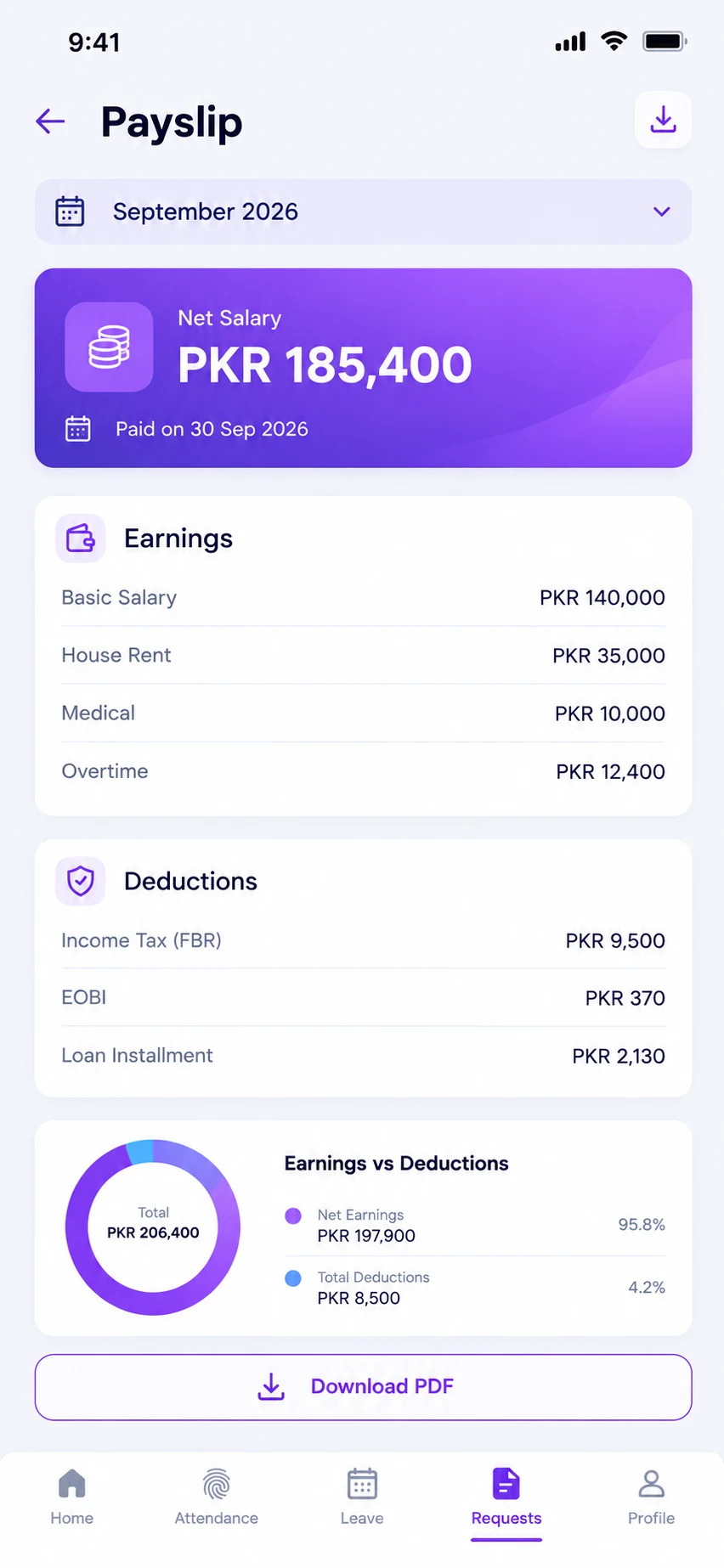
Cane does not change the federal base. On eobi.gov.pk the employer pays 5% of the minimum wage and the employee pays 1%, for each insured person. Gross salary is the wrong multiplier, and so is a daily-wage total. From 1 July 2026, Circular No. 01/2026-27 (20 August 2026) uses Rs 40,700, the Islamabad Capital Territory minimum. The mill's line is Rs 2,035. The worker's line is Rs 407. Deposit Rs 2,442 by the 15th of the next month. The longer note is the EOBI contribution guide. The EOBI calculator checks one person. Only Rs 407 is taken from wages. A seasonal hand who is an insured person is still that sum for the months of coverage. Who is insured is not decided here.
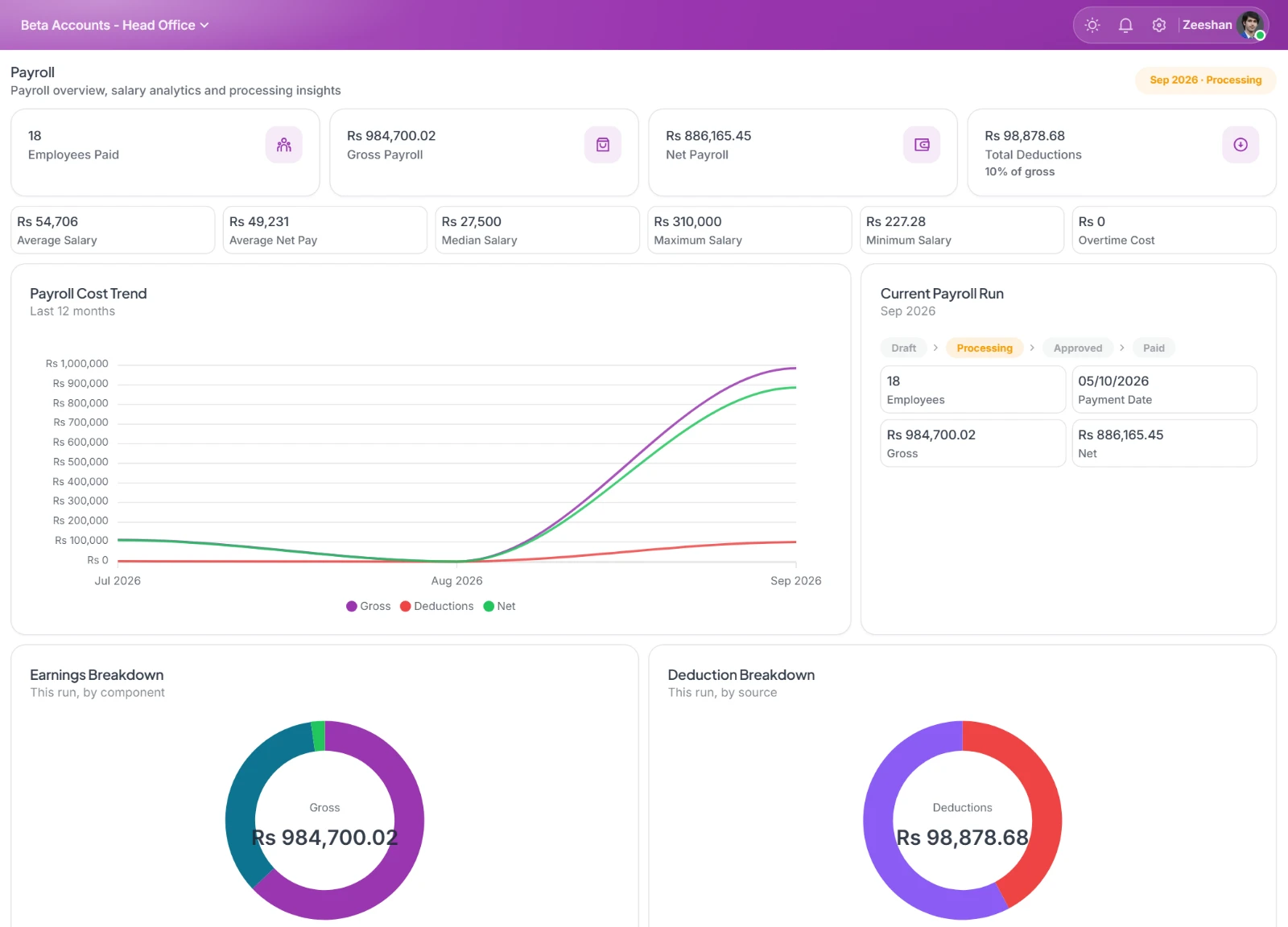
The province follows the mill, not the letterhead of the group. Punjab mills configure PESSI. Sindh mills configure SESSI. PESSI's overview states an employer contribution of 6% of wages, and the employer may not recover that share from the worker. The ceiling is a setting. The February 2026 figure is on the PESSI contribution guide, so it is not repeated. Sindh is the SESSI contribution guide. A head office in one province is not a reason to paste that scheme onto every mill. The social-security line is marked on Enterprise. The payroll module starts on Growth. Confirm both on pricing before you assume Growth already calculates the provincial line. FBR salary tax under Section 149 is withheld from annualised pay. For the current slabs, use the salary tax guide and the tax slab calculator.
Two mills are two branches once the plan includes them. Devices, public holidays and the provincial scheme do not travel with the sugar. Starter, Growth and Enterprise each include one branch on the published plans. Premium is quoted when you need custom branches. That limit is on pricing. A Starter account is not two statutory branches, one in Punjab and one in Sindh. The note is multi-branch HR software. The module is organisation management. Local tables describe those districts, not a national census and not StreamHCM customers: the Jhang profile counts five sugar mills and the Chiniot profile counts three. Rahim Yar Khan is the southern Punjab crushing-season page. Sargodha names sugarcane among the crops. Faisalabad is the accounts city many groups already use. A Sindh mill carries SESSI. Karachi is that province's payroll profile, not a claim that a named mill stands there.
Getting started before the next crush
The StreamHCM desk is in Lahore: 68 MB, Zainab Tower, Model Town, Link Road. You do not have to host a visit at the mill. From there the permanent list and the seasonal list you already hold are imported, one gate device is connected, crush shifts and the quieter off-season shifts are mapped, and one campaign period is paid in parallel with the sheet you trust.
Fourteen days are on every plan. No card is taken on this site. Try a single mill and its gate. Compare attendance, approved extra hours, a daily-wage line, EOBI and the provincial social-security line before a second mill is added. The request goes through the contact page. PKR plans are on pricing. Modules are on features. If crushing week is the wrong week to experiment, begin with the fitters who stay after the season and load the seasonal names before the next opening date.
Frequently asked questions
No. Agriculture HR software is the crop, the grower's hired labour, ginning and collection. Manufacturing HR software is the year-round factory pattern. The sugar-mill roster is the crush, the gate, the cane yard, the weighbridge, the off-season workshop and the season-end settlement.
The Sugar Factories Control Act, 1950, as published on the Punjab laws site, defines the crushing season as 1 October to 30 June next. Section 8 says crushing starts not later than a date the Government specifies, which shall not be later than 30 November. Confirm that year's start date with the Government notice. A Sindh mill follows the Sindh instrument. The Sindh text is not copied here.
Yes. An employment type keeps the rules apart. Seasonal joiners can be imported in a batch, paid from the gate's attendance, and closed with a final settlement when the contract ends. The permanent workshop crew stays on the same list. Approved days or amounts for the period can sit beside time-based pay.
Yes. Night shift is a shift type, and a shift that crosses midnight stays one attendance day. You define the start, the end and the grace minutes. The off-season maintenance roster can use a different shift template on the same branch.
Organisation management holds branches, and each branch can have its own devices, shifts, holiday calendar and statutory scheme. On the published plans, Starter, Growth and Enterprise each include one branch. Premium is quoted with custom branches. A Punjab mill can carry PESSI and a Sindh mill can carry SESSI once the plan includes both. EOBI stays federal.
Final settlement uses the same attendance the wages were paid from, plus the leave, loans and advances on the record. The gratuity guide explains the standing-order rule. The final settlement calculator is a model. The in-product settlement tool is marked on Enterprise. Check the current gratuity terms in the gratuity guide.
No. The team is based in Lahore and supports sugar-mill customers remotely. The software is cloud-based. The 14-day trial does not take a card on this site.
Sources
- Sugar Factories Control Act, 1950 (punjablaws.gov.pk): crushing season, section 8, and the factory definitionpunjablaws.gov.pk
- District Jhang: industry table, including five sugar millsjhang.punjab.gov.pk
- District Chiniot: industry table, including three sugar millschiniot.punjab.gov.pk
- EOBI: contribution rates (eobi.gov.pk)eobi.gov.pk
- PESSI overview: 6% employer contribution (pessi.punjab.gov.pk)pessi.punjab.gov.pk
- FBR Withholding Tax Rate Card, Tax Year 2027 (Section 149)download1.fbr.gov.pk
See StreamHCM running your HR
Request a 14-day trial. No card is taken on this site.