

Status as of November 2026
The Punjab Labour Code 2026 is Act IX of 2026. The footnote on the Act text says the Provincial Assembly passed it on 4 February 2026, the Governor assented on 10 February 2026, and it was published in the Punjab Gazette (Extraordinary) dated 10 February 2026, pages 4183 to 4331.
Section 1(3) says the Code comes into force on a date the Government notifies in the official Gazette. Reports conflict. The Nation, on 29 May 2026, reported the Code as officially enforced under a notification. FedEE, on 3 September 2026, and ABS & Co said the commencement notification had not been issued. This site could not open the official Gazette or labour.punjab.gov.pk to confirm either account. Check the commencement notification with the Punjab Labour and Human Resource Department, or with your adviser, before you change a policy. Treat every rule below as what applies once the Code is in force. This page does not pick a side.
Section 435(1) lists 26 laws that the Code repeals on commencement. The list includes the Factories Act, 1934, the Payment of Wages Act, 1936, the Punjab Maternity Benefit Ordinance, 1958, the Industrial and Commercial Employment (Standing Orders) Ordinance, 1968, the Companies Profit (Worker's Participation) Act, 1968, the Shops and Establishment Ordinance, 1969, the Punjab Industrial Relations Act 2010 and the Punjab Minimum Wages Act 2019. Section 435(2) keeps things already done under those laws, including notifications, rules and orders, in force until they are repealed or amended, and treats them as done under the matching provision of the Code.
Who the Code covers
Section 2(1) applies the Code to all workers, employers, principals and occupiers at all workplaces in all sectors in Punjab, other than civil servants regulated under the Punjab Civil Servants Act, 1974, defence services of Pakistan and services or installations exclusively connected with or incidental to those defence services, and the police service including law-enforcement agencies and civil armed forces. Section 2(2) applies it to all establishments operating in Punjab. Section 2(3) applies it to workplaces belonging to the Government and other workplaces inside Punjab.
Section 3 says a contract, internal work regulation, collective agreement or other agreement cannot exclude or limit the Code, and a worker cannot sign away a right the Code gives. Section 3(3) allows terms that are more favourable than the Code.
A micro-enterprise, in section 131(g), is an establishment in which fewer than ten employees are employed, directly or through any other person, or were so employed on any day in the preceding twelve months. That definition matters for the shorter notice period in section 150(5).
What HR has to change, by area
The table is a map of the sections below. It is not a substitute for the section. Each duty applies once the Code is in force.
| Area | Code section | What HR must do |
|---|---|---|
| Written agreement and employment card | ss.141 and 143 | Put agreements of more than one month in writing, in duplicate, and hand a copy over before work starts. Issue a card with name, personnel number, designation and photograph. |
| Probation | s.144 | Cap probation at three months. Either side may end it without notice. If it expires with no notice, treat the person as confirmed. |
| Pay date, bank credit and payslip | s.165 | Pay monthly wages before the seventh day of the next month, in rupees, by bank credit, with the employer bearing the transfer cost. Issue an itemised payslip, including leave balances. |
| Hours and overtime | ss.176 and 179 | Keep ordinary hours at 8 a day and 48 a week, with the seasonal and continuous-process exceptions. Overtime needs consent, and is capped at 2 hours a day and 8 a week. |
| Leave | ss.192, 193, 195, 197 and 198 | Annual leave is 18 calendar days after 12 months, on a January to December year. Sick leave is 8 days at full pay. Casual leave is 10 days. |
| Notice, certificate and final pay | ss.146, 150, 158 and 165(12) | Give 30 days' written notice or 30 days' last-drawn pay, unless it is gross misconduct. Issue the certificate before the tenth working day expires. Pay dues before the second working day expires. |
| Gratuity | ss.159 and 160 | After one year, 30 days' remuneration per year, except for gross misconduct, and not in an establishment with fewer than 20 workers. Apply the three pay-band caps. |
Employment agreement and employment card
Section 141(1) says an employment agreement may be oral or in writing. Section 141(3) then requires it to be in writing unless it is for a term not exceeding one month. A missing written form does not, by itself, invalidate the agreement: that is the proviso to section 141(3) and section 141(6). Section 141(4) requires the agreement in duplicate, one copy for each side. Section 141(5) requires the employer to give the employee a copy before employment starts. Section 141(7) requires any change in a condition of employment to be communicated in writing within seven days of the change.
Section 143 requires every employee to be given an employment card showing name, personnel number, designation and photograph, displayed during working hours.
Probation
Section 144(1) allows a probationary period, and says it shall not exceed three months. Section 144(2) says that on a fixed-term agreement the probation must be proportionate to the expected duration and the nature of the work. Section 144(3) says either party may end the agreement during probation without notice. Section 144(4) says that if the employer does not expressly end it, and the period expires with no notice from either side, the employee is presumed to have cleared probation. Section 144(6) counts a successfully concluded probation toward length of service. Section 144(5) says the employer may not require a second probation for the same job after a successful one.
The Standing Orders position, which applies until the Code commences for a covered establishment, is on the probation period page.
Pay dates, bank payment and the payslip
Section 165(1) says the basic wage shall not be below the notified minimum wage. The rupee figure is a notification, not a number in this section. Use the minimum wage guide for the rate your province has notified, and check the Labour Department before you lock a payroll setting.
Section 165(4) says the wage period shall not exceed one month. Section 165(5) requires all remuneration and dues to be paid in Pakistani rupees by credit to the employee's bank account. Section 165(6) makes both sides responsible for opening an account where the employee does not have one. Section 165(7) says the employer bears the cost of the transfer. Piece rates are allowed under section 165(8) and (10): the rate per unit, the work and the quantity must be told to the worker before the work starts.
Section 165(11) sets the pay dates. Daily pay is due at the end of the working day or shift. Weekly pay is due on the last working day of the week, before the weekly rest day. Fortnightly pay is due before the end of the second day after the fortnight. Monthly pay is due before the expiry of the seventh day of the succeeding month.
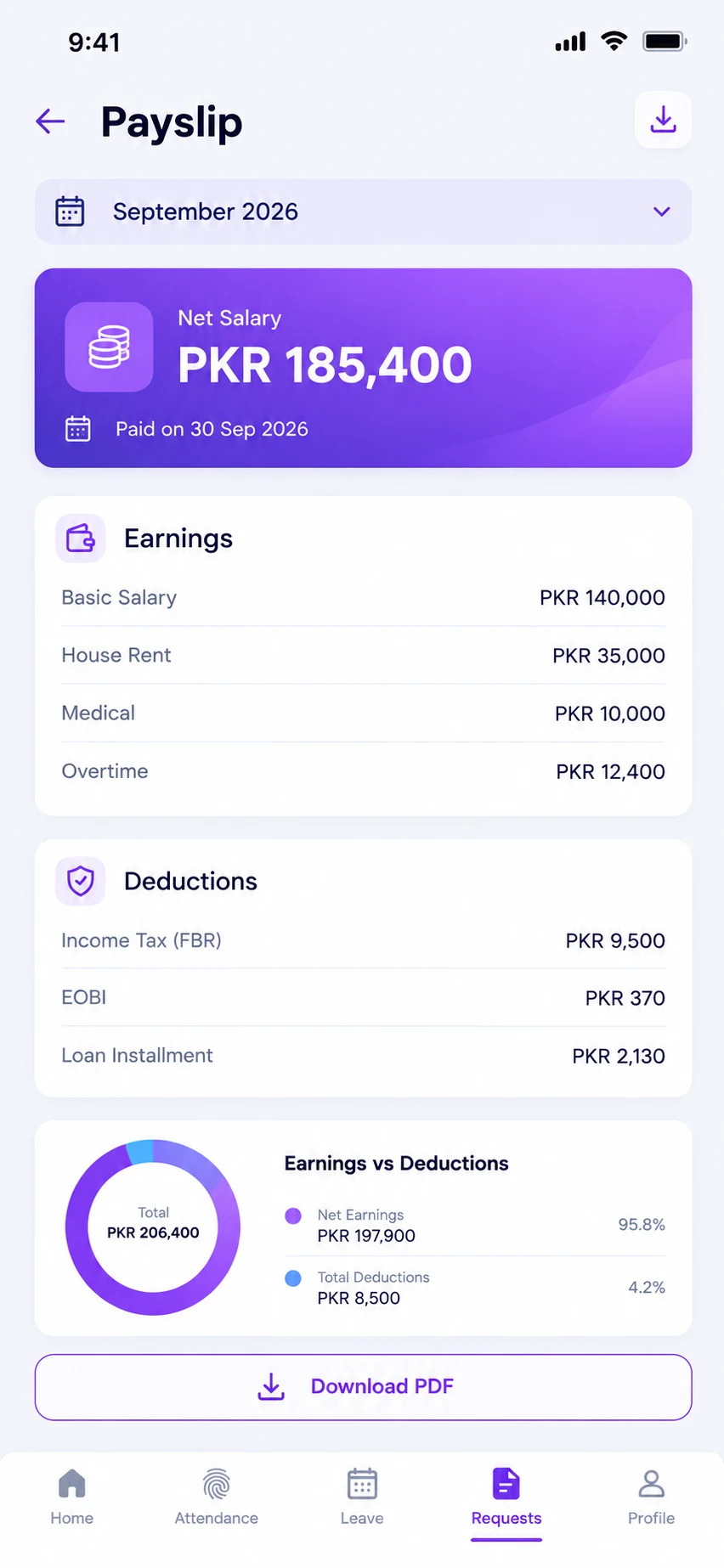
Section 165(15) requires an accurate itemised payslip every month, in writing, showing basic wage, allowances (statutory, non-statutory, and any other payment), gross remuneration, deductions including statutory and non-statutory contributions and fines, total deductions, net remuneration, other payments (overtime and any bonus or ex-gratia), total payment, and leave balances for annual, casual and sick leave. The salary slip format is the practical layout. Payroll compliance software still has to print those fields: see payroll compliance software.
Deductions
Section 168(1) says remuneration is paid without deductions except those authorised by or under the Code. Section 168(2) limits deductions to the kinds the Code lists. The list includes statutory contributions, income tax payable by the worker, non-statutory social insurance with the employee's agreement, court or other authority orders, fines under section 169, absence under section 170, damage or loss under section 171, house accommodation or services supplied, recovery of advances under section 173, and payments to co-operative societies, insurance schemes and saving schemes, including a provident fund where the conditions in those sections are met. A deduction that is not on that list is not a payroll setting you can invent.
Hours and overtime
Section 176(1) sets normal hours at eight a day and forty-eight a week. Section 176(2) allows a seasonal establishment nine hours a day and fifty a week. Section 176(3) allows a workplace where work is continuous for technical reasons fifty-six hours a week. Section 176(4) lets an employee who worked under eight hours on some days of the week work up to two extra hours on other days of that week without an overtime rate, provided the week stays inside forty-eight hours.
Section 176(5) says a woman employee may work after 8:00 pm only with her prior consent, and the employer must arrange pick-up and drop-off at her doorstep or the nearest possible place, except where the employer provides a separate hostel at or near the premises and arranges the necessary transport.
Section 179(1) allows overtime only if the employee agrees, and only up to two hours on any day and eight hours in a week. A workplace on a five-day week may, with the Chief Inspector's approval, require up to ten hours a day without overtime pay, provided the week does not exceed 48 hours. Section 179(3) pays ordinary overtime and weekly-rest-day overtime at two times the normal hourly remuneration, and public-holiday overtime at three times. The employer and employee may instead agree a substitute weekly rest day within three days, or, for a public holiday, both a substitute day off and a compensatory rest day within seven days. The same subsection still requires compensatory rest for at least two weekly rest days a month and at least half of the declared public holidays in the year.
Those are the Code figures. The factories and shops figures that apply until commencement, and in provinces the Code does not cover, stay on the overtime rules guide.
Leave: annual, sick, casual, maternity and paternity
Section 192(1) gives eighteen calendar days of annual leave with pay after twelve months of continuous service. The leave year runs from 1 January to 31 December, whatever the joining date. An employee may request annual leave before twelve months, in proportion to length of service, and a part year is pro-rated under section 192(2). Section 192(14) makes an agreement to give up annual leave void.
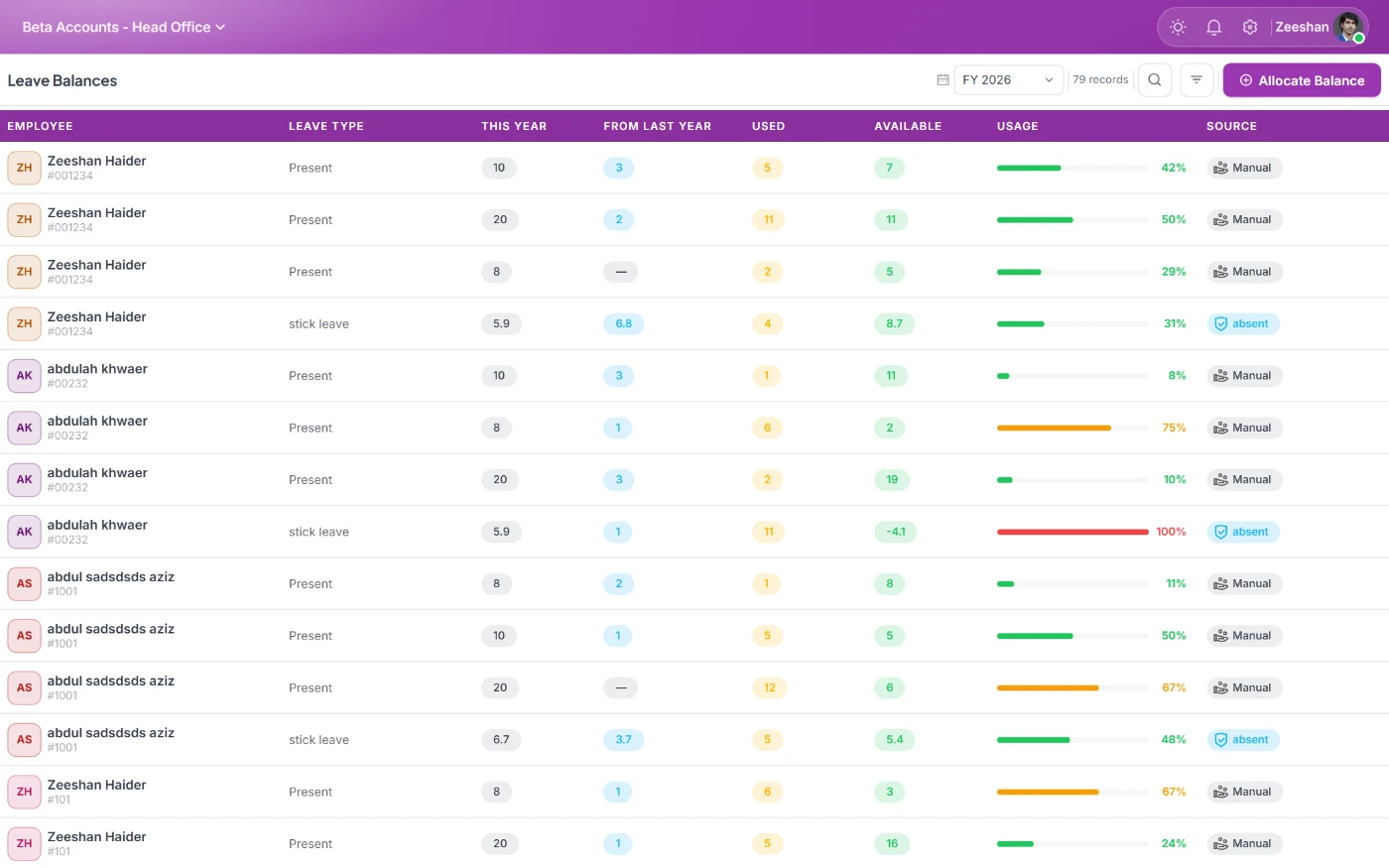
Section 193 gives eight days of sick leave with full remuneration in a calendar year. No sick leave beyond two days is granted unless a registered medical practitioner certifies it. Sick leave accumulates until the total due reaches sixteen days, and then stops. Section 195 gives ten days of casual leave with full remuneration in a calendar year, ordinarily not more than three days at a time, with no accumulation, and not taken with another type of leave.
Section 197 pays maternity leave at the woman's average monthly remuneration: six weeks immediately before and including the day of delivery, eight weeks after that day (six of them compulsory), one further week for certified complications where the life of the mother or child is at risk, and four weeks for a certified miscarriage or medical termination of pregnancy. She needs at least six months' employment in the workplace immediately before the expected day of confinement. Section 198 gives a male employee seven calendar days of paternity leave at full pay, starting on or immediately before the birth. It is not allowed if he already has two or more surviving children.
The factories and shops figures already written up for Punjab, Sindh, Khyber Pakhtunkhwa and Balochistan are on the leave entitlements guide. This page does not convert those older numbers into a before-and-after claim. Maternity notice and pay outside the Code are on the maternity leave page.
Notice, termination, the certificate and final pay
Section 146(2)(d) lists unsatisfactory performance as a valid reason for the employer to end the agreement, subject to subsections (3) to (6). Section 146(3) requires a written order that states the reason. Section 146(4) requires a chance to respond to allegations about conduct or performance, unless the employer cannot reasonably be expected to provide it. Section 146(5) says the agreement shall not be terminated for unsatisfactory performance unless the employer has given appropriate instructions and a written warning, and the employee continues to perform unsatisfactorily after a reasonable time to improve.
Section 150(1) entitles the employee to 30 days' written notice, or last-drawn remuneration for 30 days in lieu, unless the employee is guilty of gross misconduct. Section 150(2) gives the employee the same choice when resigning: 30 days' written notice, or 30 days' last-drawn remuneration in lieu. Section 150(4) adds one paid day off each week during notice, on top of the weekly rest day, so the employee can look for work, at times convenient to both sides. Section 150(5) shortens this, in a micro-enterprise, to 14 days' written notice or fourteen days' last-drawn remuneration, for both sides. Gross misconduct is defined in section 151, not in this paragraph.
Section 158 requires a certificate before the tenth working day after termination expires. It must show the employer's name and address, the nature of the business, the length of continuous employment, the capacity in which the employee was employed, and the reason for termination. It must not evaluate the work unless the employee asks. The experience letter page separates that certificate from a letter a new employer asks for. Notice practice outside the Code is on the notice period page.
Section 146(6) requires remuneration earned and other dues, including pay for unavailed annual leave, before the second working day from the termination expires. Section 165(12) requires remuneration and other dues within two working days of termination.
Gratuity and the three caps
Section 159(1) says the gratuity section does not apply to an establishment in which fewer than 20 workers are engaged. Section 159(2) gives, on termination by either party after a year of continuous service, a gratuity equal to 30 days' remuneration for every year of service, unless more favourable terms have been agreed. Gross misconduct is the exception. After the first year with the same establishment, a period of more than six months counts as a full year. The base is the remuneration paid in the last month for a fixed-rated employee, or the highest pay drawn in the last twelve months for a piece-rated employee.
Section 160(1) then caps that gratuity. The table below follows the section. Do not read a cell as applying outside the row it sits in. Have the band and the reason for termination checked before you pay. Section 160(3) says the section does not affect a right to gratuity that had already accrued under a law in force immediately before the Code. The factories and shops gratuity write-up is the gratuity and final settlement guide.
| Category | When gratuity is payable | Maximum under section 159 |
|---|---|---|
| 1. Average monthly remuneration not more than five times the monthly minimum wage notified by the Government | Termination by either party, other than for gross misconduct | Uncapped |
| 2. Average monthly remuneration above category 1, but not more than ten times that minimum wage | Termination for redundancy or retrenchment only | Twelve months of remuneration |
| 3. Average monthly remuneration above ten times that minimum wage | Termination for redundancy or retrenchment only | Six months of remuneration |
Pay secrecy and non-compete clauses
Section 162 prohibits an employer from requiring an employee to disclose, or not to disclose, remuneration and the terms that are reasonably necessary to work out remuneration outcomes. The employer also must not stop the employee discussing those matters, including with another employee. The ban covers the employment agreement, internal work regulations, collective agreements, and any other direction.
Section 163(1) and (2) make a term that restrains an employee from a lawful profession, trade or business void, and section 163(3) says the employer must not put a void term in the agreement. The section does not apply to a managerial or administrative employee whose average monthly remuneration exceeds five times the monthly minimum wage for an unskilled worker notified by the Government. Section 163(4) still allows a term that prohibits disclosure of trade secrets and confidential proprietary client information, and solicitation of the employer's clients that the employee learned about during the employment.
Discipline where the employer has more than 20 employees
Sections 154 and 155 apply to employers employing more than twenty employees. Section 154(2) requires a written charge sheet within one month of the misconduct or of the date it comes to the employer's notice, two weeks for the employee to explain, and, if the explanation is not satisfactory, suspension and an inquiry. Section 154(5) limits suspension to seven days at a time and four weeks in total, except where the matter is pending before an arbitrator, a Labour Court, a tribunal, a mediator or a conciliator. Suspension is on full pay: the same remuneration the employee would have received if not suspended.
Section 155 requires the inquiry officer to put the charges and evidence to the employee and to take a written defence. Section 155(4) requires recommendations within forty days of the inquiry starting. Section 155(5) requires the employer, within one week of that report, to pass a speaking order in writing, either setting the charge aside or imposing a penalty under section 156.
Section 156 lists the penalties: censure; a fine, in the manner the Code prescribes, of up to three percent of the remuneration payable in a month; withholding of increment or promotion for up to two years; reduction to a lower post for up to two years; termination with payment of all benefits including gratuity; or dismissal without remuneration in lieu of notice.
Workers' participation fund
Chapter 5.3, sections 254 to 260, sets up a workers' participation fund under the Code. Section 435(1)(o) is the repeal, on commencement, of the Companies Profit (Worker's Participation) Act, 1968. This page does not quote a profit percentage or a unit split from Chapter 5.3. The rates already checked for the older statutes are on the WPPF and WWF guide.
What to update once the Code commences
- Offer-letter and appointment templates: written terms, the copy handed over before day one, and a seven-day rule for changes.
- Payslip fields: basic, allowances, gross, each deduction including fines, net, overtime and bonus, the total, and annual, casual and sick leave balances.
- The payroll calendar: monthly wages before the seventh day of the next month, and final dues within two working days.
- Notice clauses: 30 days or 30 days' pay, 14 days in a micro-enterprise, and one paid job-search day a week during notice.
- Non-compete clauses: void except for the managerial and administrative staff above the five-times wage line in section 163. Confidentiality and client non-solicitation can stay.
- The leave policy: a January to December year, 18 calendar days of annual leave after 12 months, 8 days of sick leave and 10 days of casual leave, on the terms in sections 192, 193 and 195.
How StreamHCM records the same items
These are modules already on the product, not a legal opinion. Payroll keeps a payroll calendar with cut-off and pay dates, and it produces itemised digital payslips. Leave holds leave types with formula balances and accrual, so the balances section 165(15) asks for are on the same record as the payslip. Overtime in payroll is calculated from attendance rather than typed in again. Final settlement sits in the same payroll module. Documents holds the agreement, the warning and the certificate. A Lahore employer still confirms the commencement notification before switching a policy on.