
Half day, short leave and late arrival: attendance status rules

Written by the StreamHCM team for HR and payroll managers in Pakistan. Updated on 8 November 2026.
A day is present, short leave, half day or absent because of minutes worked against thresholds you set on the shift. Late and early are a second rule: how many minutes past the start, or before the end, still count as on time. Pakistani factories and shops laws limit hours. They do not, in the sections cited below, hand you a grace period or a half-day minute count. The form in the screenshot is still blank.
Hour limits below are the ones already quoted in the overtime guide, from the Factories Act 1934 text on the Khyber Pakhtunkhwa site and the shops laws checked for that guide on 24 October 2026. This page does not add a new statutory figure. It is not legal advice.
Two different clocks
HR teams often use one phrase, "he was short today", for three different facts.
- Status of the day. How many minutes count as present, short leave, half day or absent.
- Late or early. Whether the punch missed the start or the end by more than the grace on that shift.
- Overtime. Whether the hours crossed the daily or weekly line in the Act that covers the workplace, and at what rate those extra hours are paid.
A person can be present and still late. A person can be inside the statutory day and still be half day if your minute rule says so. Paying the second fact as if it were the third is how a late deduction and an overtime line both appear, or neither does, for the same punch.
What the blank form's ladder shows
The screenshot is new shift setup before entering details. Shift name is empty. Start and end are empty. The summary says "Untitled shift". Short Leave is switched on. The minute boxes still hold the form's starting values: Present After 540, Half Day After 210, Short Leave After 370. The chips under those boxes are drawn from those values:
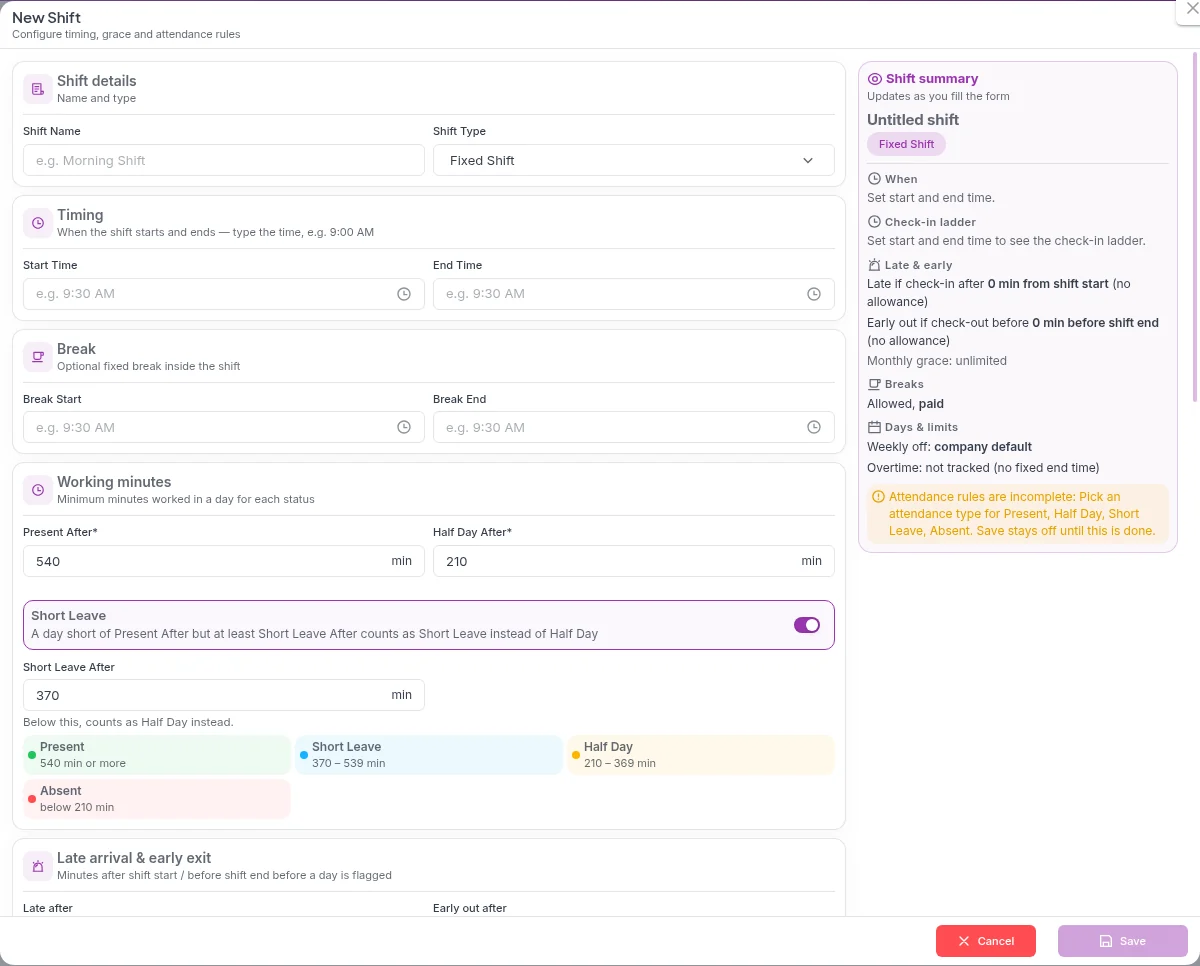
| Status on the blank form | Minutes the chips show | What it is not |
|---|---|---|
| Present | 540 min or more | Not a statutory definition of a full day. 540 minutes is nine hours, which happens to match one factory daily limit cited in the overtime guide. A KP shop's cited daily limit is eight hours. Do not keep 540 for that reason alone. |
| Short leave | 370–539 min | Not a national "short leave" entitlement. The form's own sentence says a day short of Present After, but at least Short Leave After, counts as short leave instead of half day. The switch is on in this capture. |
| Half day | 210–369 min | Not the half-day leave type in the leave module. This chip is an attendance status from minutes worked. Half-day leave is a request against a leave balance. |
| Absent | Below 210 min | Not an automatic resignation or a misconduct finding. It is the status when worked minutes fall below the half-day line on this form. |
The line under Short Leave After says that below that field the day counts as half day instead. Turn the switch off only if the company does not use a short-leave status. If you change 540, 370 or 210, the chips change with them. The numbers in the table are the blank form, not a policy we recommend you adopt.
The same form says attendance rules are incomplete until you pick an attendance type for Present, Half Day, Short Leave and Absent, and that Save stays off until then. This screenshot does not show those types selected.
Late arrival and early exit
The bottom of the form is labelled "Late arrival & early exit" and explains that it flags minutes after shift start, or before shift end, before a day is flagged. The visible labels are "Late after" and "Early out after". This capture does not show a number typed into either field.
The summary, because start and end are still empty, says late if check-in is after 0 min from shift start (no allowance) and early out if check-out is before 0 min before shift end (no allowance). It also says monthly grace is unlimited. Read that as the empty form's summary, which the screen says updates as you fill the form. It is not a saved grace policy.
A saved example sits on a different screen. The shifts list shows General Shift, a fixed shift from 09:00 AM to 06:00 PM, with grace 0 / 0 min. Zero and zero means that row is not ignoring late or early minutes. It is one active shift in the list, not a legal minimum.

Where the statutes stop
The overtime guide, checked on 24 October 2026, quotes these limits and does not quote a grace period:
- Factories Act 1934, on the Khyber Pakhtunkhwa text: a non-seasonal factory crosses into overtime above nine hours in a day or forty-eight in a week. Section 37 requires a rest interval so that work does not run more than six hours before a one-hour break, or more than five hours before a half-hour break. Section 46 deals with a shift that crosses midnight.
- Punjab shops, on the text cited there: nine hours a day and forty-eight a week, and no more than six hours continuously without a rest of at least one hour.
- Khyber Pakhtunkhwa shops: eight hours a day and forty-eight a week for an adult.
None of those sentences says "ignore the first ten minutes" or "210 minutes is a half day". If a later notification or the Punjab Labour Code says something this page has not quoted, use that text. Do not drop the citations above because a government site times out. The overtime guide keeps the source links.
A rest interval inside the working day is the break block on the shift form. The blank form's break fields are empty. Its summary says breaks are allowed and paid while the form is still empty. Confirm that against the policy and the rest rule that applies before you rely on it.
Numbered workflow
- Pick the Act from the list above that covers the establishment. Write the daily and weekly limits next to the shift, so the clock times you type are not longer than you can explain.
- Decide the four statuses in ordinary language: what you will call a full day, a short day that is not a half day, a half day, and an absence.
- Turn those into minutes and type them over the form's starting 540, 370 and 210. If you do not use short leave, switch that control off and say so in the policy.
- Choose the attendance types the form asks for. Save stays off until that notice is cleared. This screenshot has not cleared it.
- Type the late and early grace you are willing to ignore. The General Shift example uses 0 and 0. Another shift can differ. Say the number in the policy so two managers do not invent two numbers.
- Separate this ladder from leave. A half-day leave request is approved in leave management. A half-day attendance status is minutes worked. Using one to overwrite the other produces a day that is both on leave and absent.
- Keep overtime on its own rule. Estimate pay in the overtime calculator, then match the divisor to the contract. The calculator's default divisor is not a figure in the sections cited here.
- If the same person is late often enough that you may dismiss, move to a warning letter and show-cause notice. The attendance status is evidence. It is not the disciplinary order.
A worked day, using only the blank form's chips
These minutes are the chips on the empty form, so you can see the ladder. They are not a worked example from a saved shift, and they are not pay.
- 600 minutes worked sits in Present (540 or more).
- 400 minutes worked sits in Short Leave (370–539), because the short-leave switch is on. It does not fall through to half day.
- 250 minutes worked sits in Half Day (210–369).
- 180 minutes worked sits in Absent (below 210).
Change any of the three boxes and these four results move. A late punch is still a separate flag. Someone with 600 minutes can also be late if they crossed the late-after line, once that line has been typed. This capture has not typed it.
What a trial should prove
If you are comparing StreamHCM with FlowHCM, ResourceInn or WebHR, do not ask which homepage mentions half day. Ask each product to take one shift, your minute lines, one late punch and one short day, and show the status. Then see whether payroll reads that status. The comparison checklist and the FlowHCM and ResourceInn pages are written that way. They do not rank those products, and this page does not rank WebHR either.
Questions
Are 540, 370 and 210 the legal definitions of a full day and a half day?
No. They are the minutes already filled in when the New Shift form opens, before a name or a clock time is typed. Change them to the policy you actually run.
Does Pakistani law set a grace period of 10 or 15 minutes?
Not in the Factories Act and shops sections cited on the overtime guide. Those sections limit hours and, in places, require a rest interval. Grace minutes are a company rule stored on the shift. The General Shift row on the shifts list is set to 0 and 0.
What is short leave on this form?
With the switch on, a day that is short of Present After but still at least Short Leave After counts as short leave instead of half day. The blank form's own chips then read Present 540 min or more, Short Leave 370–539 min, Half Day 210–369 min, and Absent below 210 min.
Does a late mark replace a warning letter?
No. Marking a day late is an attendance result. Dismissal for misconduct still follows the written process in the warning-letter guide. A stack of late marks does not skip that process.
Is overtime the same as staying past the half-day line?
No. The minute ladder decides the status of the day inside the shift. Overtime is extra time against the statute and the contract, explained in the overtime guide. The blank form says overtime is not tracked until a fixed end time exists.
Related: how to set up a shift, overtime rules, attendance tracking, leave management, attendance calculator, attendance management.
Put the minute rules on the shift, then punch a short day
Request a 14-day trial. No card is taken on this site.