
Overtime calculation rules in Pakistan: factories and shops
Overtime in Pakistan is not one national formula. A factory and a shop can sit on the same road and still follow different hour limits, and the provinces have amended the shops laws differently. This guide sets out the overtime rules that are actually written in the Factories Act 1934 and in the shops and establishments laws of Punjab, Sindh, Khyber Pakhtunkhwa and Balochistan, and it says plainly where a figure could not be confirmed.
Start with the law that covers the workplace
Two families of statute do most of the work. Factories are covered by the Factories Act 1934, as published by the Government of Khyber Pakhtunkhwa, unless a province has replaced it for that establishment. Shops, commercial establishments and many offices are covered by a shops and establishments law. Using the factory rule in a retail shop, or the shop rule on a factory floor, is how payroll disputes start.
Provinces have not stood still. Sindh enacted the Sindh Shops and Commercial Establishment Act 2015 and the Sindh Factories Act 2015. Khyber Pakhtunkhwa enacted the Khyber Pakhtunkhwa Shops and Establishment Act 2015. Punjab's consolidated text of the Shops and Establishments Ordinance 1969 is on the Punjab Laws website, and Punjab has also consolidated a wider set of labour statutes in the Punjab Labour Code 2026. This page does not quote overtime numbers from the Punjab Labour Code or the Sindh Factories Act, because those figures were not confirmed from the texts checked on 24 October 2026. If either of those statutes applies to you, read it before you lock a payroll rule.
The practical test is the establishment, not the city on the letterhead. A Faisalabad spinning mill and a Sialkot export unit are factory questions. A Gulberg showroom or a Clifton call centre is a shops question. Groups with both should attach the rule to the branch, not to the company.
The overtime rate each cited law actually states
Where the text is clear, the rate is twice the ordinary rate. Where the official PDF is not clear, this guide does not tidy it up.
Factories Act 1934, section 47: overtime is paid at twice the worker's ordinary rate of pay. In a non-seasonal factory that is triggered above nine hours in a day or forty-eight hours in a week. In a seasonal factory it is above nine hours in a day or fifty hours in a week.
Punjab Shops and Establishments Ordinance 1969, section 9, on punjablaws.gov.pk: overtime wages are calculated at double the ordinary rate of wages. A proviso says no overtime is payable to a contract worker employed on a piece-rate basis.
Khyber Pakhtunkhwa Shops and Establishment Act 2015, section 9: overtime wages are calculated at double the ordinary rate of wages payable to the employee.
Sindh Shops and Commercial Establishment Act 2015, section 9, in the PDF published by the Sindh Directorate of Labour: the sentence says overtime wages shall be calculated at "double and ordinary rate of wages". That is not a clean multiplier. This guide does not treat it as confirmed double time. Confirm the Sindh rate with the provincial labour department or your adviser.
Balochistan Code text of the West Pakistan Shops and Establishments Ordinance 1969, section 9: overtime wages are calculated at double the ordinary rate of wages.
Factories Act 1934: hours, night shifts and ordinary pay
On the text published by the Khyber Pakhtunkhwa government, section 34 limits an adult worker to forty-eight hours in a week, or fifty hours in a seasonal factory. A proviso allows fifty-six hours in a week for continuous technical work. Section 36 limits the day to nine hours, with a male adult in a seasonal factory allowed ten. Section 37 requires rest intervals, either so that no one works more than six hours before a one-hour break, or more than five hours before a half-hour break. Section 38 limits the spread-over, including rest, to ten and a half hours, or eleven and a half in a seasonal factory, unless the province permits more.
Section 46 matters for night shifts. When a shift crosses midnight, the following day is the twenty-four hours beginning when the shift ends, and hours after midnight count towards the previous day, unless the province orders the opposite for a specified factory. A mill that splits a night shift across two calendar dates will miscount both the daily limit and the overtime.
Section 47 then defines the money. "Ordinary rate of pay" means all remuneration that can be expressed in money and that would be payable if the contract were fulfilled. It excludes the value of house accommodation, light, water, medical attendance or other amenity; any employer contribution to a pension fund or provident fund; any travelling allowance or the value of a travelling concession; and any gratuity, bonus or share in the profits of the factory. Piece-rated workers are covered by subsection (3): the province may, in consultation with the industry, fix a time rate close to their average earnings, and that time rate is their ordinary rate for this section. Section 47-A says an adult worker may be required to work overtime only where the work still conforms to the Act and the rules.
The copy of section 47 on the Khyber Pakhtunkhwa site does not state a separate weekly ceiling such as sixty hours. Older reprints sometimes include a subsection that this text no longer shows. This guide therefore does not state a sixty-hour factory cap.
Twice the rate means the overtime hour is paid at double
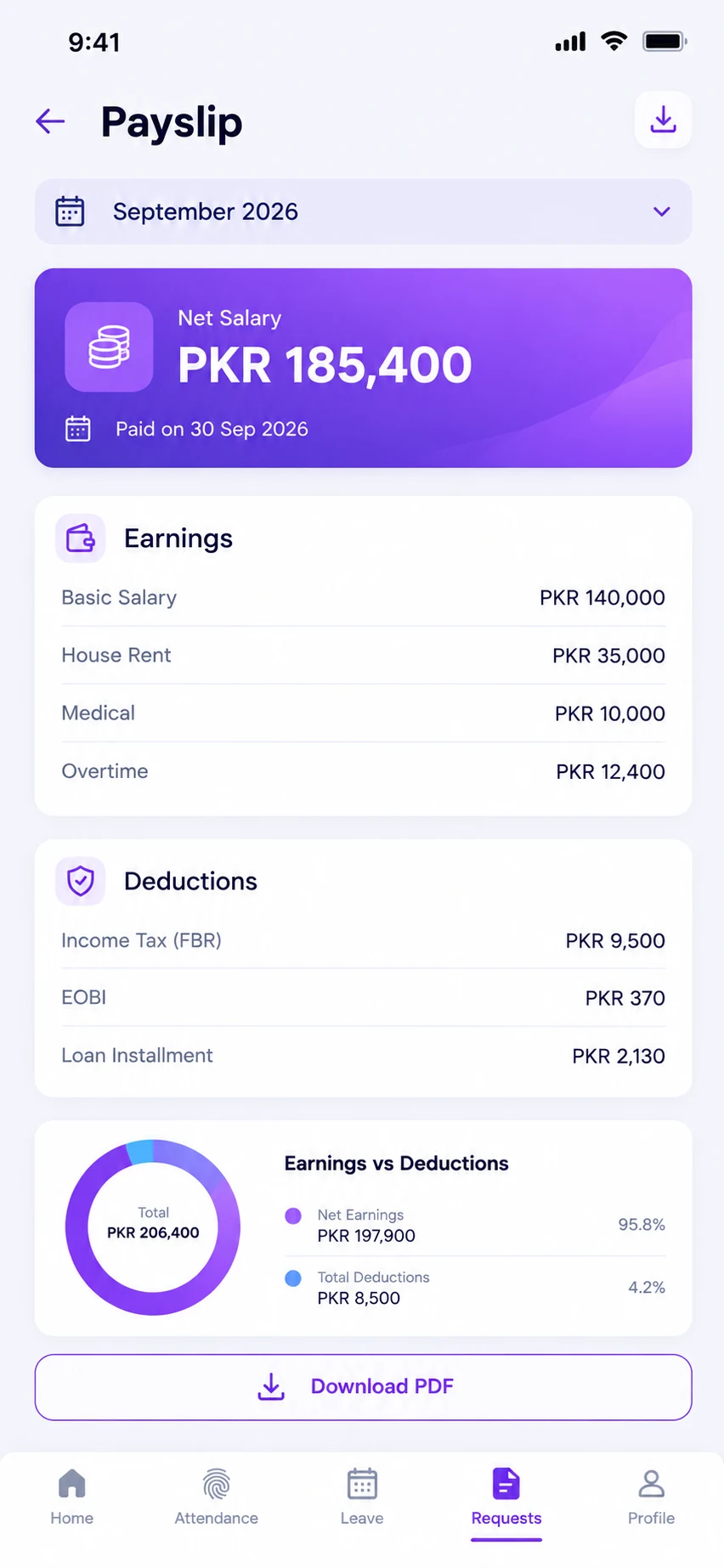
Section 47 says the worker is entitled, in respect of the overtime worked, to pay at the rate of twice his ordinary rate of pay. Punjab and Khyber Pakhtunkhwa shops laws use the same idea: wages for the overtime work are calculated at double the ordinary rate. Read that as the overtime hours themselves being paid at double, not as ordinary pay for those hours plus another double on top. Adding the double again produces a triple rate the cited sections do not state.
Pay the overtime on the hours that actually crossed the daily or weekly line in the law that applies. A non-seasonal factory worker who works ten hours has one overtime hour that day under section 47, not ten. A week that stays inside forty-eight hours, with no day above nine, has not triggered section 47 at all.
Shops laws: the hour limits are not the same province to province
Punjab's current text on punjablaws.gov.pk, section 8, says no adult employee shall be required or permitted to work more than nine hours a day and forty-eight hours a week, and no adolescent more than seven hours a day and forty-two hours a week. Overtime is allowed in the circumstances in the proviso, including stock-taking, accounts, settlement and other prescribed periods, but the total overtime hours for an adult must not exceed six hundred and twenty-four in a year. Adolescents are not to be given overtime. An adult also must not work more than six hours continuously without a rest interval of at least one hour.
Sindh's 2015 Act, section 8, uses the same nine-hour day and forty-eight-hour week for adults, and seven and forty-two for adolescents. The annual cap in that section is one hundred and fifty overtime hours for an adult and one hundred for an adolescent. Spread-over, including rest, is ten hours in winter and eleven in summer for an adult.
Khyber Pakhtunkhwa's 2015 Act is different on the ordinary day. Section 8 limits an adult to eight hours a day and forty-eight hours a week, and a young person to seven and forty-two. The proviso allows overtime above those limits, but says the total number of hours so worked by an adult must not exceed twenty-four hours in a week. In context, "so worked" is the overtime the proviso has just described. It is a weekly overtime cap, not a twenty-four-hour working week, which would contradict the forty-eight-hour week in the same section. Spread-over is twelve hours for an adult.
The Balochistan Code copy of the 1969 Ordinance, section 8, keeps the nine-hour day and forty-eight-hour week, and caps adult overtime at one hundred and fifty hours in a year and a young person's at one hundred. That is the older West Pakistan cap. Do not copy it onto Punjab, whose consolidated text now says six hundred and twenty-four hours, or onto Khyber Pakhtunkhwa, which uses a weekly cap instead.
Islamabad is not given a separate shops figure here. No ICT-specific consolidation was confirmed for this guide. A factory in Islamabad that is still under the Factories Act 1934 follows section 47 of that Act.
These sections do not give you one hourly divisor
None of the sections cited above says that a monthly salary is divided by 26 days, or by 30, or by the calendar days in the month, before it is divided by eight hours. The ordinary rate has to be worked out from the definition in the Act that applies and from the employment contract. Inventing a divisor and calling it the law is how a "compliant" sheet fails an inspection.
StreamHCM's public payroll calculator and attendance calculator use a default of gross pay divided by 26 and then by 8, with a multiplier that defaults to 2. That 26 is the calculator's working-day default. It is not a figure in section 47 or in the shops sections quoted here. Use it as a model, then match the divisor to the contract and the statute that actually covers the branch. The minimum wage guide is a separate question: overtime math does not replace the duty to pay at least the notified minimum for the hours that minimum covers.
A worked example, with a made-up hourly rate
The rupee figure in this example is assumed, so the arithmetic is easy to follow. It is not a wage set by any notification.
Take a non-seasonal factory worker whose ordinary rate, after applying the section 47 exclusions, is Rs 250 an hour. On one day the worker is at the machine for 11 hours, and the week is otherwise inside the limits. The hours above nine are two. Those two hours are paid at twice Rs 250, which is Rs 500 an hour, so the overtime pay for the day is Rs 1,000. You do not also pay a further Rs 500 an hour on top of that Rs 500. If the same worker's week reaches fifty hours without any day above nine, the two hours above forty-eight are the overtime hours instead. Do not count the same hour twice, once on the day and again on the week.
Change the workplace and the threshold changes. The same 11-hour day in a Khyber Pakhtunkhwa shop, where section 8 sets an eight-hour day, crosses the line one hour earlier than the factory example. A Punjab shop still uses nine hours, but the year's overtime total has to stay inside six hundred and twenty-four hours. A seasonal factory uses fifty hours in the week, not forty-eight, before section 47 applies.
What to keep, and how payroll should pick it up
Section 47(4) of the Factories Act lets the province prescribe the registers a factory must keep to show overtime compliance. The West Pakistan Shops and Establishments Rules 1969, as published on the Khyber Pakhtunkhwa code site, require a register of employment and remuneration. Whatever the form number in your province, an inspector asks for the same story: who worked, which hours were overtime, which rate was used, and whether the pay matches the attendance.
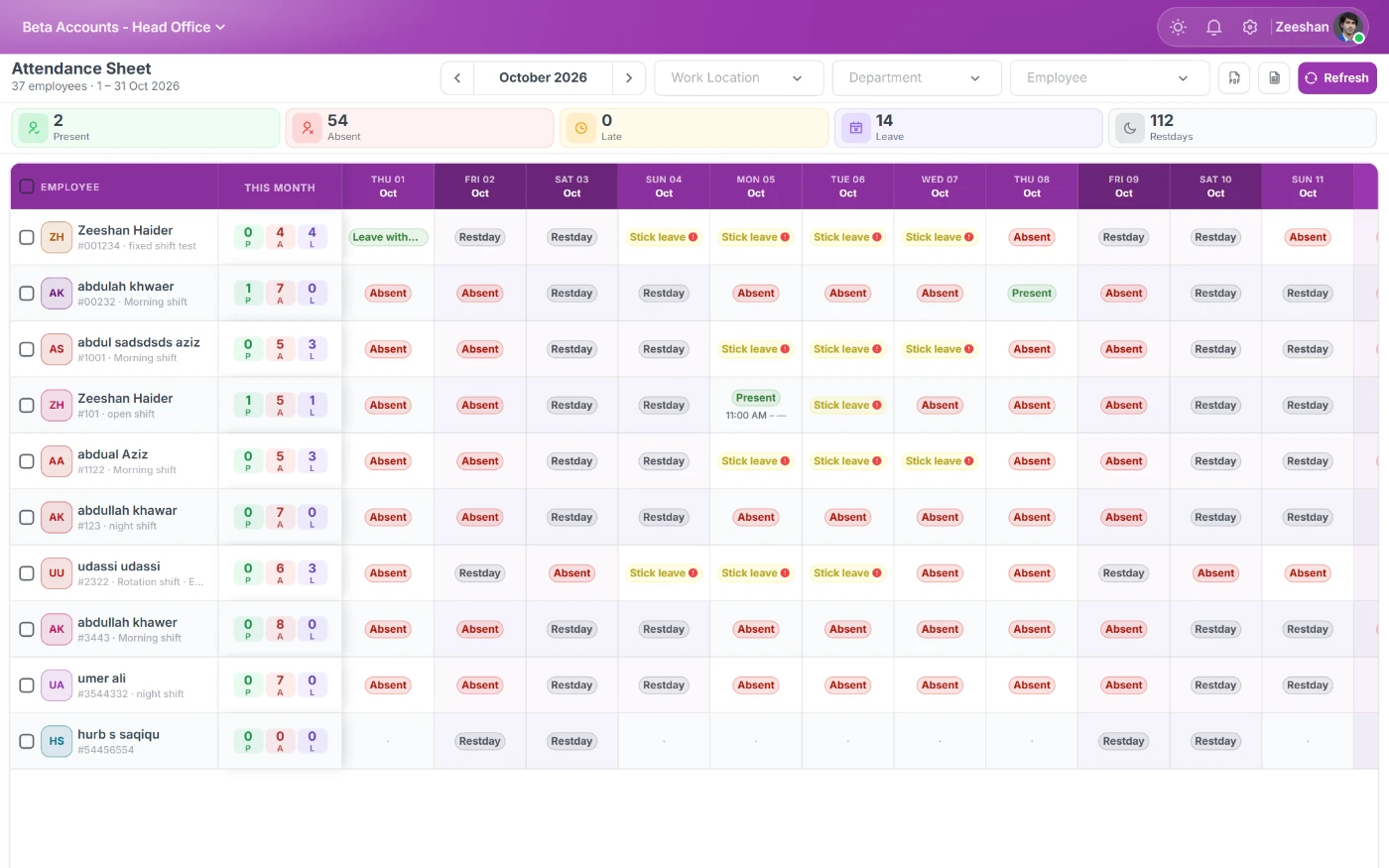
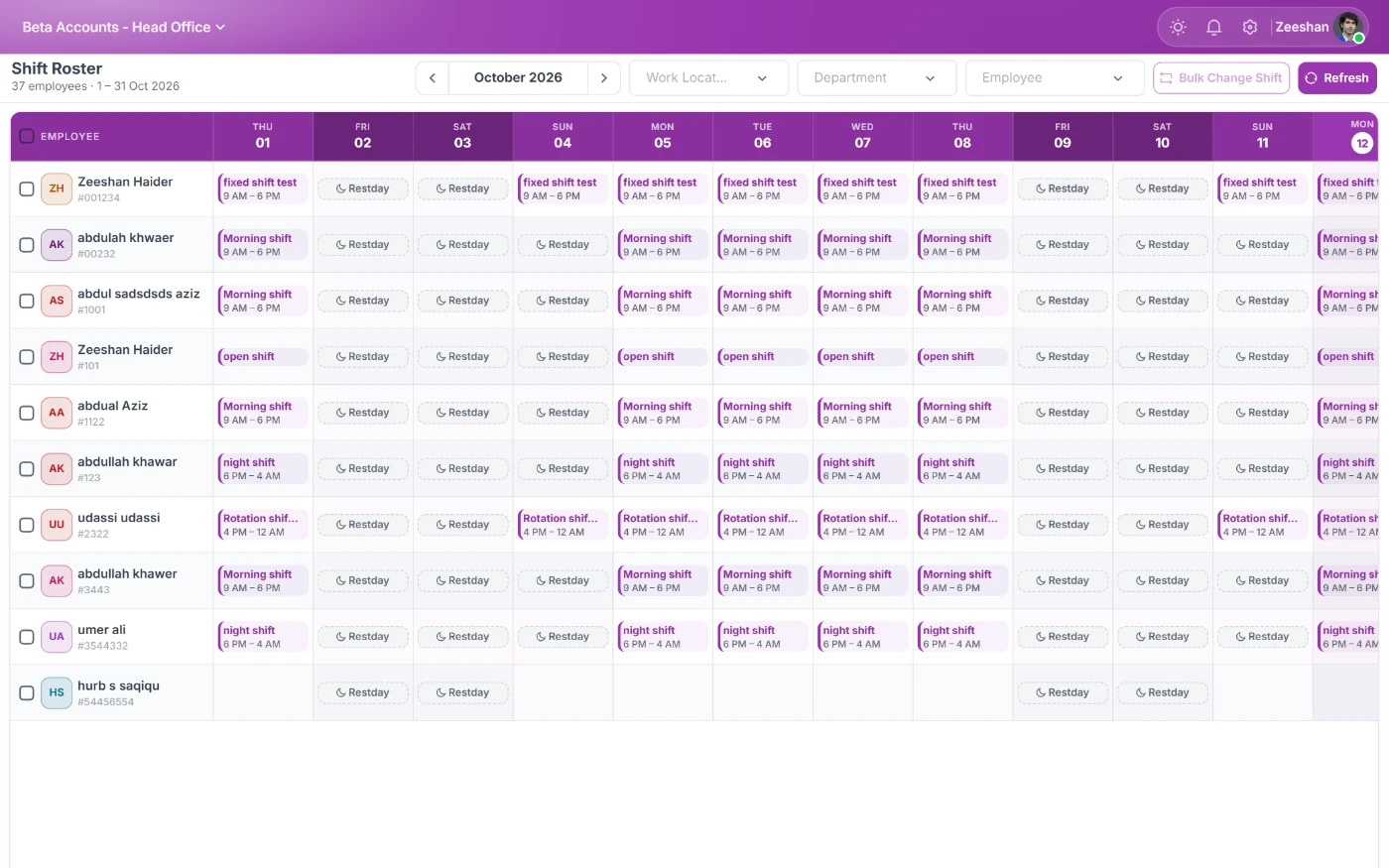
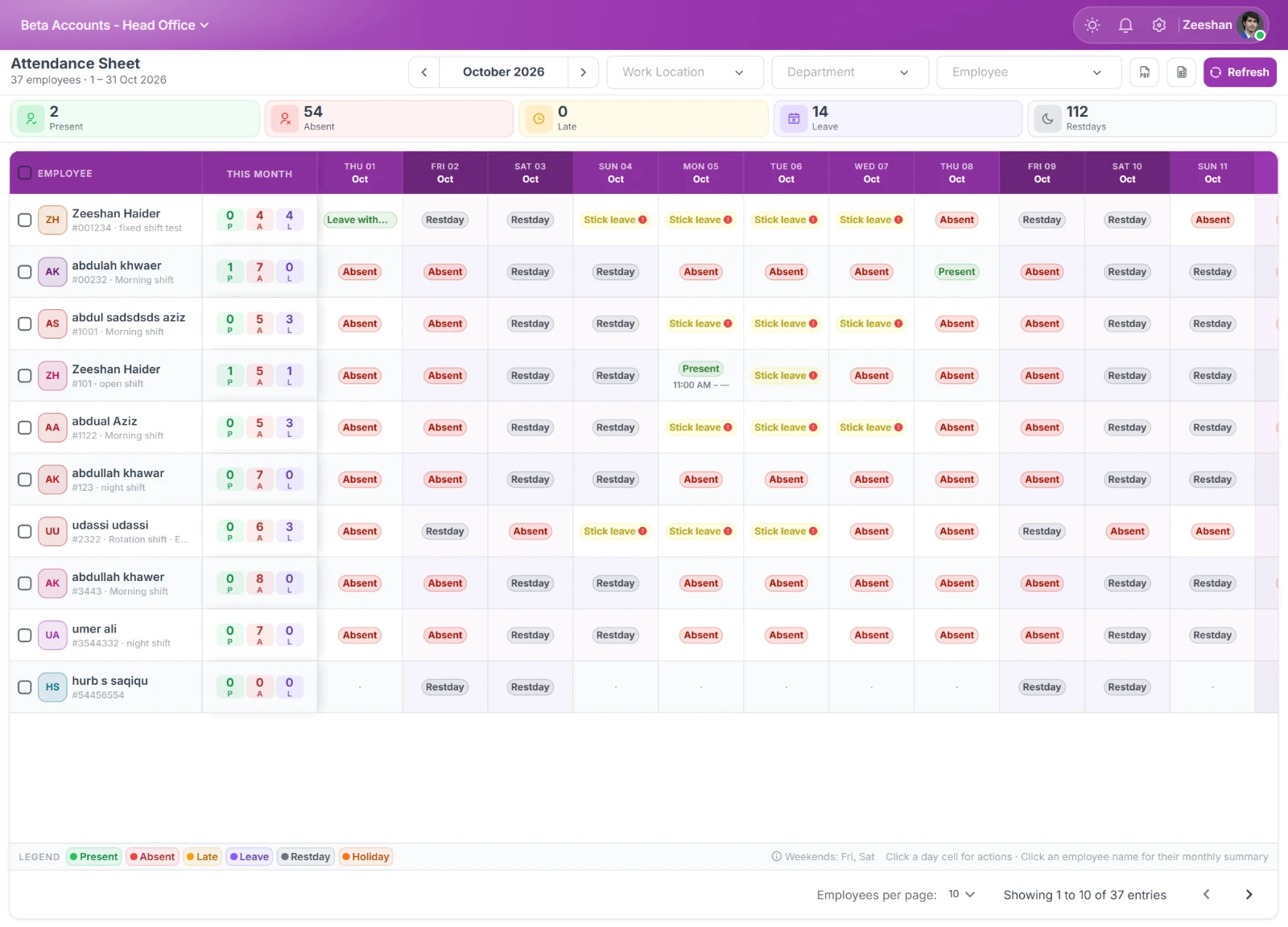
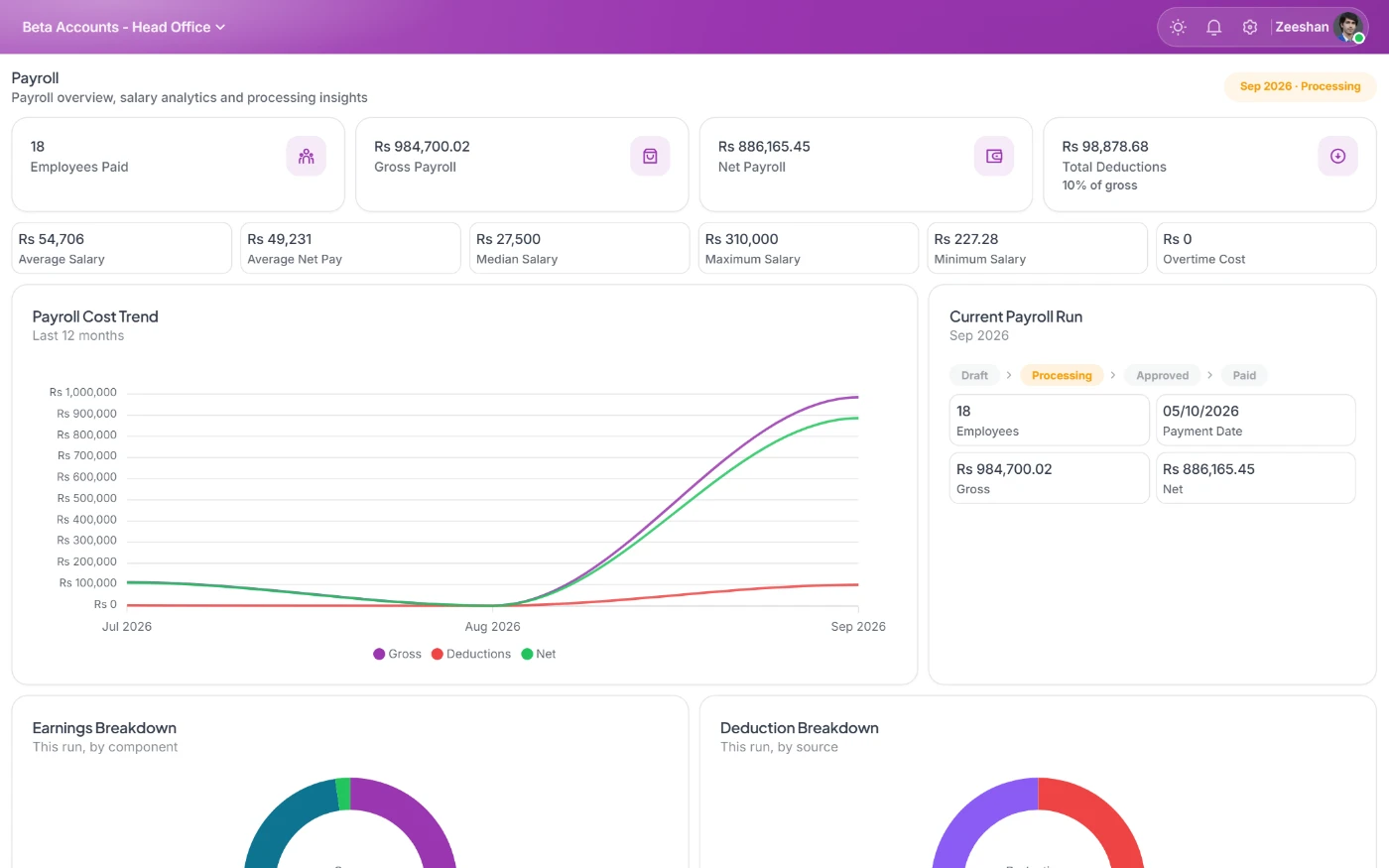
That story falls apart when the biometric machine, the overtime approval and the payslip live in three files. Shift scheduling has to know the scheduled hours before attendance can mark what was extra, and payroll software has to use that approved extra rather than a number typed in on the night before payday. StreamHCM keeps the shift, the punches and the pay run in one record. You set the multiplier and the daily and weekly thresholds for the branch. Overtime can be held for approval before it is paid. The payslip shows the overtime as its own line, which is the line someone will compare with the register.
Export units already know the next question. Buyers' auditors ask whether every hour was paid, including overtime, at the rate the law or the contract required. A report taken from the same attendance the worker was paid on is the record that answers it. The guides index collects the contribution and wage guides that usually sit next to this one in that audit file.
About this guide
Checked against the sources listed below on 24 October 2026. It is general information for employers, not legal advice. Provincial amendments, notifications and the Punjab Labour Code 2026 may change a rule for your establishment. Confirm the text that applies before you change a pay run.
Frequently asked questions
Under section 47 of the Factories Act 1934 it is twice the ordinary rate of pay. Punjab and Khyber Pakhtunkhwa shops laws, and the Balochistan Code text of the 1969 Ordinance, say double the ordinary rate. The Sindh shops Act PDF says "double and ordinary rate", which this guide does not treat as a confirmed multiplier.
Under the Factories Act text cited here, a non-seasonal factory crosses the line above nine hours in a day or forty-eight in a week. A seasonal factory crosses it above nine hours in a day or fifty in a week.
No. The KP Shops and Establishment Act 2015 limits an adult to eight hours a day and forty-eight a week. Punjab's shops ordinance, on the current Punjab Laws text, uses nine hours a day and forty-eight a week.
Not in the sections cited here. Those laws define an ordinary rate but do not prescribe 26 as the divisor. A calculator default of 26 is a payroll convention, not a figure from those sections.
In a factory, section 47(3) allows the province to fix a time rate near their average earnings and treat that as the ordinary rate. In Punjab shops, section 9 says no overtime is payable to a contract worker employed on a piece-rate basis. Those are different rules. Do not mix them.
Sources
- Factories Act 1934, Government of Khyber Pakhtunkhwakp.gov.pk
- Punjab Shops and Establishments Ordinance 1969 (punjablaws.gov.pk)punjablaws.gov.pk
- Sindh Shops and Commercial Establishment Act 2015 (Directorate of Labour Sindh PDF)dglabour.gos.pk
- Khyber Pakhtunkhwa Shops and Establishment Act 2015 (KP Code)kpcode.kp.gov.pk
- West Pakistan Shops and Establishments Ordinance 1969 (Balochistan Code)balochistancode.gob.pk
- West Pakistan Shops and Establishments Rules 1969 (KP Code)kpcode.kp.gov.pk
See StreamHCM running your HR
Start a 14-day free trial, no credit card required.