
The complete guide to employee attendance tracking in Pakistan
July 10, 2026

Attendance tracking looks like the simplest problem in HR, until a company actually tries to get it right. It touches payroll accuracy, labour law compliance, overtime costs, and how much HR trusts the data it's reporting to leadership. Get it wrong, and every process downstream of it, payroll, leave balances, performance reviews, inherits the error.
For growing companies in Pakistan, attendance tracking usually starts with a register or a spreadsheet, moves to a standalone biometric device once headcount makes manual entry unmanageable, and eventually needs to become part of a connected system once the company has more than one location or any field-based staff. This guide walks through that progression and what to get right at each stage.
The problem with manual attendance registers
A paper register or a shared spreadsheet works fine for a handful of employees sitting in one room. It stops working the moment a company has shift workers, more than one office, or staff who travel. Manual registers are easy to falsify, tedious to reconcile against payroll, and produce no usable data, nobody is running trend analysis on a stack of signed paper sheets.
The real cost shows up at month-end, when HR has to manually cross-check attendance against leave requests, public holidays, and approved overtime before payroll can even start. This reconciliation step is the single biggest reason payroll runs late in companies still using manual attendance, and it's entirely avoidable once attendance is captured digitally from the start.
Biometric attendance, the standard for accountability
Fingerprint and face-recognition devices remain the standard for on-site attendance because they solve the one problem every other method struggles with: proxy attendance, where one employee clocks in for another. For factories, warehouses, retail outlets, and any workplace with a fixed location, a biometric device paired with software that syncs check-in data automatically is still the most reliable combination available.
The mistake companies make isn't choosing biometric devices, it's treating them as a standalone system instead of connecting them to payroll and leave management. A biometric device that only stores logs locally, with someone manually exporting a spreadsheet at month-end, delivers almost none of the real benefit. The value comes from the data flowing automatically into payroll the moment it's captured.
Mobile and GPS check-in for field and remote teams
Biometric devices assume employees show up to a fixed location, which doesn't work for sales teams, field engineers, delivery staff, or anyone who works across multiple sites. For these roles, mobile check-in with GPS verification has become the practical standard, an employee checks in from their phone, and the system confirms they were actually at the expected location, without requiring a physical device at every site.
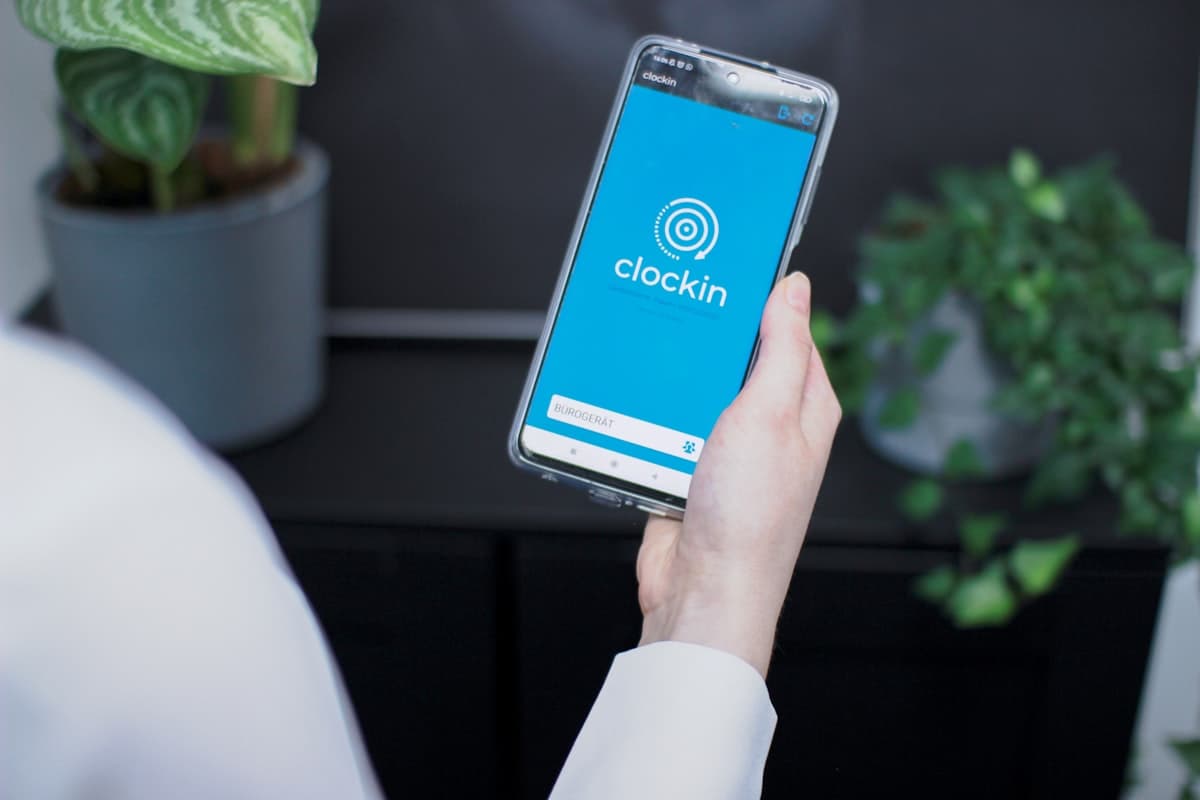
This matters more than most companies expect. A sales team with no attendance system beyond “call your manager when you start your day” has no reliable data on actual working hours, and no defensible record if a dispute over overtime or absence ever comes up. Mobile check-in closes that gap without requiring field staff to visit an office just to clock in.
What a good attendance policy should actually cover
Attendance software is only as good as the policy behind it. Before rolling out any system, a company needs clear, written rules for the situations that come up every month: what counts as a late arrival and what deduction, if any, applies; how half-days are calculated; how overtime is approved and paid; and how shift changes and swaps are handled and by whom.
Companies that skip this step end up with a system that's technically accurate but practically inconsistent, the same 12-minute delay gets excused for one employee and deducted for another, depending on which manager processed it. A written policy, configured once into the system, removes that inconsistency entirely and gives HR a consistent answer every time an employee asks “why was I marked late.”
A grace period is worth deciding deliberately rather than by accident. Most companies settle on somewhere between five and fifteen minutes before a late arrival triggers any deduction, enough to absorb normal commute variability without opening the door to habitual lateness. Whatever the number, it should be the same for every employee in a given role and location, not something a manager decides case by case.
Turning attendance data into decisions
Once attendance is flowing automatically and consistently, it becomes one of the richest data sources HR has. Patterns that are invisible in a spreadsheet, a department with unusually high late arrivals, an employee whose attendance has quietly declined over two months, a location with far more overtime than its peers, become visible in a dashboard within seconds.

This is where attendance tracking stops being an administrative chore and starts being a management tool. A manager who can see that a normally punctual employee has been arriving late three times a week for a month has a reason to have a conversation before it becomes a bigger problem, something that's nearly impossible to notice from a paper register.
Common compliance mistakes to avoid
The most common attendance compliance mistake in Pakistan is inconsistent overtime calculation, different formulas applied by different managers, with no single source of truth for what the policy actually says. The second most common is simply not retaining attendance records long enough; labour inspections and disputes can reach back further than most companies expect, and a system that only keeps the last three months of data leaves a company exposed.
The fix for both is the same: one policy, configured once into a system that every location and every manager uses, with records retained automatically rather than depending on someone remembering to archive a spreadsheet. It's not a complicated fix, but it's one that's very difficult to maintain manually once a company has more than a handful of employees.
Getting started
Companies moving off manual attendance for the first time don't need to solve every scenario on day one. Start with accurate, connected capture, biometric for fixed locations, mobile for field staff, and a written policy for the handful of situations that come up every month. Everything else, from anomaly detection to workforce analytics, becomes possible once that foundation is in place and the data flowing through it can actually be trusted.
Ready to put this into practice?
See how StreamHCM automates the workflows in this article for your team.