
HR, payroll and attendance software for the automotive sector in Pakistan
Pakistan's automotive sector is several workplaces, not one assembly hall. A vendor that stamps parts, a line that builds motorcycles or rickshaws, a tractor plant, a dealership workshop and a tyre or battery warehouse do not share a gate or a pay rule. StreamHCM keeps attendance, shifts, leave and payroll for the people those employers pay, in one cloud account. EOBI is federal. PESSI or SESSI follows the city.

What an automotive HR team switches on first
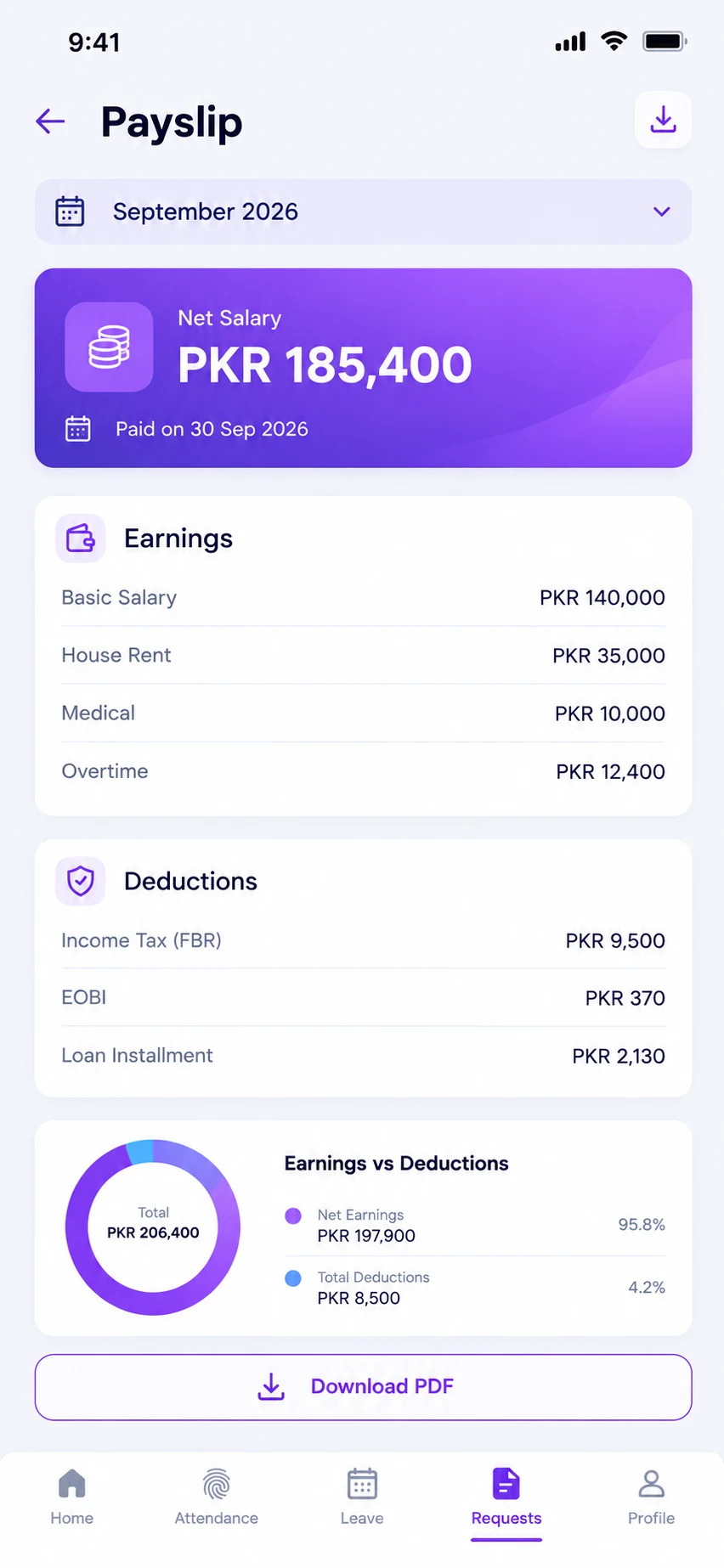
You do not have to turn on every module before the first pay run. Most employers start with the people they pay, the check-in that matches the gate they actually use, and the payslip. A production line and a workshop technician should not be forced through the same punch.
Fingerprint or face attendance at a plant gate, and a separate check-in for technicians and counter staff who are not on that line.
Shifts for a production day and a night line, including a shift that crosses midnight, with overtime held until a supervisor approves it.
Payroll that can take a monthly salary, a daily-wage amount, a piece or incentive amount, and a workshop commission for the same period.
Leave requests from the employee app, so a day a supervisor already approved on the floor is not marked absent on the register.
A branch for each plant, workshop or warehouse, with its own devices, holiday calendar and statutory rules, and one payroll draft for the group.
A training record on the employee profile, so a safety course the employer chooses to assign is not a spreadsheet beside the wage.
The sector is not one plant
This page is the automotive workforce: the vendor who supplies a part, the line that assembles a vehicle, the workshop that services it, and the counter that sells a tyre or a battery. A year-round factory that is not in this chain, whether FMCG, packaging or general engineering, is manufacturing HR software. A spinning mill is textile HR software. A truck that leaves a yard, as a logistics workforce, is HR software for logistics. The automotive page is the case where the product is a vehicle or a part, and the month mixes a production shift with a workshop job card.
The Auto Industry Development and Export Policy 2021-26, published by the Ministry of Industries and Production, states a vision of competitive manufacturing of auto parts and vehicles for the local market and for export. Its objectives section states capacity targets of 650,000 cars, LCVs and SUVs, 100,000 tractors, 20,000 heavy commercial vehicles, and 7 million two- and three-wheelers a year. Those are targets in the policy. They are not a count of people on a payroll, not a count of plants, and not this year's production. The same section describes facilities for all tiers of suppliers, from raw materials to manufacturing of parts, assembly, and after-sales support. That sentence is the shape of the workforce. It is not a customer list. The policy's messages name the Pakistan Automotive Manufacturers Association and the Pakistan Association of Automotive Parts and Accessories Manufacturers as associations that took part in the policy. Naming them is not a claim that any member uses any particular software.
The policy's new-product chapter covers small cars, tractors, and two- and three-wheelers. For tractors it says the local industry was manufacturing tractors from 35 horsepower to 85 horsepower at the time of that text, and it sets out incentives for smaller and larger categories. For two- and three-wheelers it names motorcycles, motorcycle rickshaws and auto rickshaws. This page does not reprint the duty tables, and it does not treat a horsepower band as a headcount. A vendor that machines a part, a line that assembles a motorcycle or a rickshaw, and a workshop that services what has already been sold are three rosters. City pages already describe the places many of those sites sit. Karachi and Lahore are the cities the same policy's review of the earlier 2007-12 programme names for cluster development. Sheikhupura and Gujranwala are the other city pages a multi-site group in this sector tends to open. The Dera Ghazi Khan profile counts one tractors factory. That cell is not a national total. The HR software Pakistan page is the product overview. This page is the automotive version.
The line, the night shift and the job card
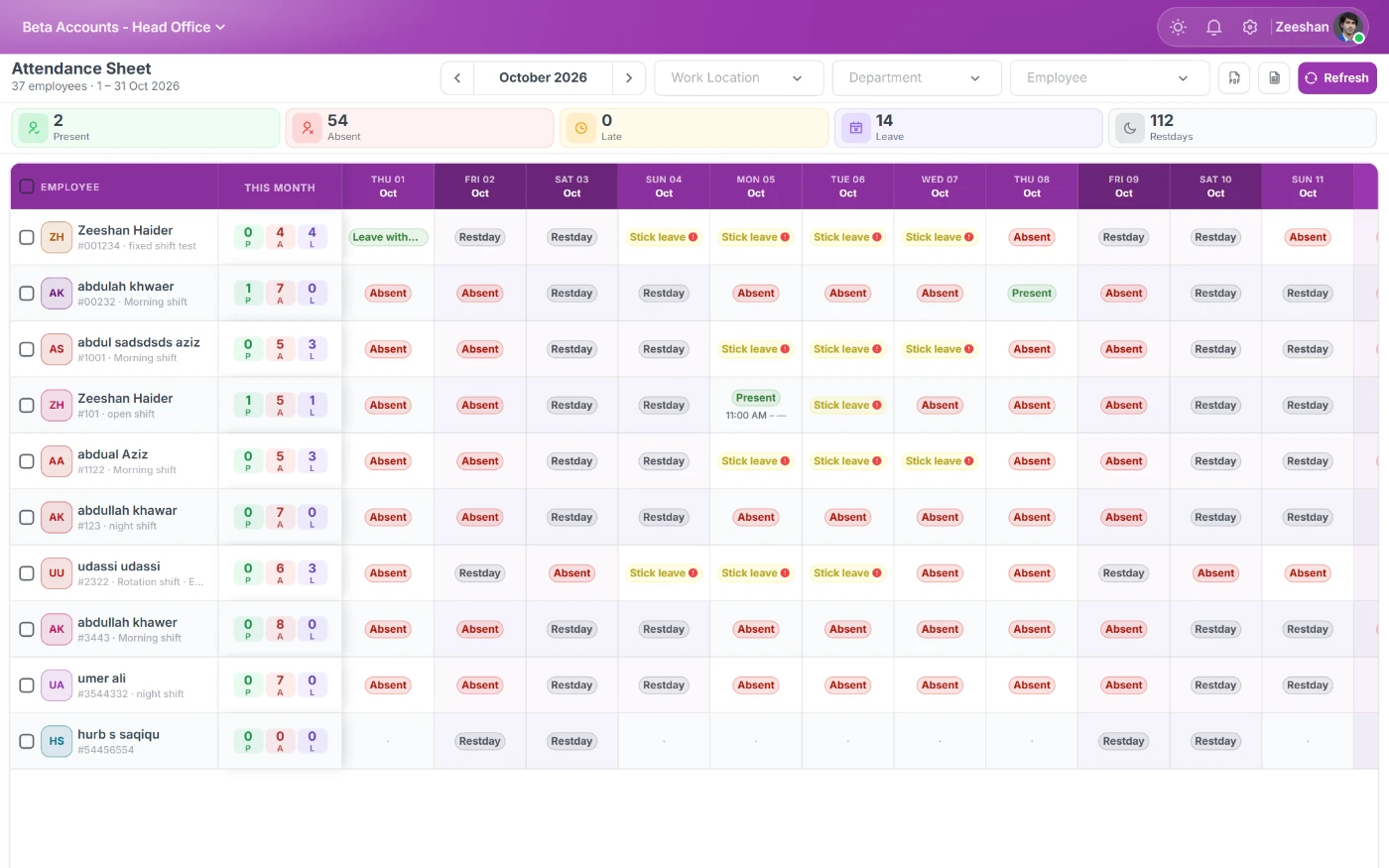
A production day is a shift with a start, an end and a grace period. A second shift, or a night that ends after midnight, has to stay one attendance day. If the system rolls the day at midnight, the second half looks like a missing punch and the wage is short. StreamHCM's shift module includes fixed, rotational, split and night shifts, plus templates and bulk assignment by branch. The shift scheduling page and the shift module list those types. A practical setup note is how to set up a shift. A dealership that opens the workshop on a Saturday and the accounts desk on a weekday should not be forced onto the plant's roster.
Overtime should come from the approved punches, not from a number typed into the sheet after the line has already stopped. StreamHCM calculates overtime from attendance and can hold it until a supervisor approves it. The multiplier is a setting you choose. Pakistan does not use one national overtime formula. A factory and a commercial establishment can follow different hour limits, and the provinces have amended the shops laws differently. A plant is often a factory. A dealership or a parts counter may be a commercial establishment. Read overtime rules in Pakistan before you lock a rule, and compare a month in the overtime calculator. The calculator's default is double time. That default is a model, not a statutory rate this page is taking for every plant, vendor or workshop. The overtime request inside the employee app is listed on Enterprise on the pricing page. The shift definitions themselves sit with attendance, which starts on Starter.
Piece-rate and incentive pay show up on the line and in the workshop for different reasons. A vendor may pay part of the month by the piece: a bracket, a rim, a finished batch. A workshop may pay a technician a commission or an incentive for the jobs closed in the period. StreamHCM does not replace the job card or the sheet that counts pieces. It gives payroll a place to receive the approved quantities, days or amounts for the period, beside time-based pay, allowances and deductions. You review the total against the minimum wage of the province where the person works. That wage is not one national number. The minimum wage by province guide says where a 2026-27 notification was found and where it was not. This page does not restate those rates. StreamHCM stores the figure you enter. A piece amount or a commission is not a substitute for that check. Payroll software is where the salary structure is set.
The plant gate and the workshop door
A fingerprint or face device at the plant gate is the usual production entrance. Biometric attendance and face recognition are marked on Enterprise. A change of shift at a busy gate is why the device matters: the punch has to land on the right person and the right shift before payroll reads it. Biometric attendance is the device page, including ZKTeco. ZKTeco payroll integration is the note on punches moving into the wage. Attendance management describes grace minutes, late marks and a missed punch.
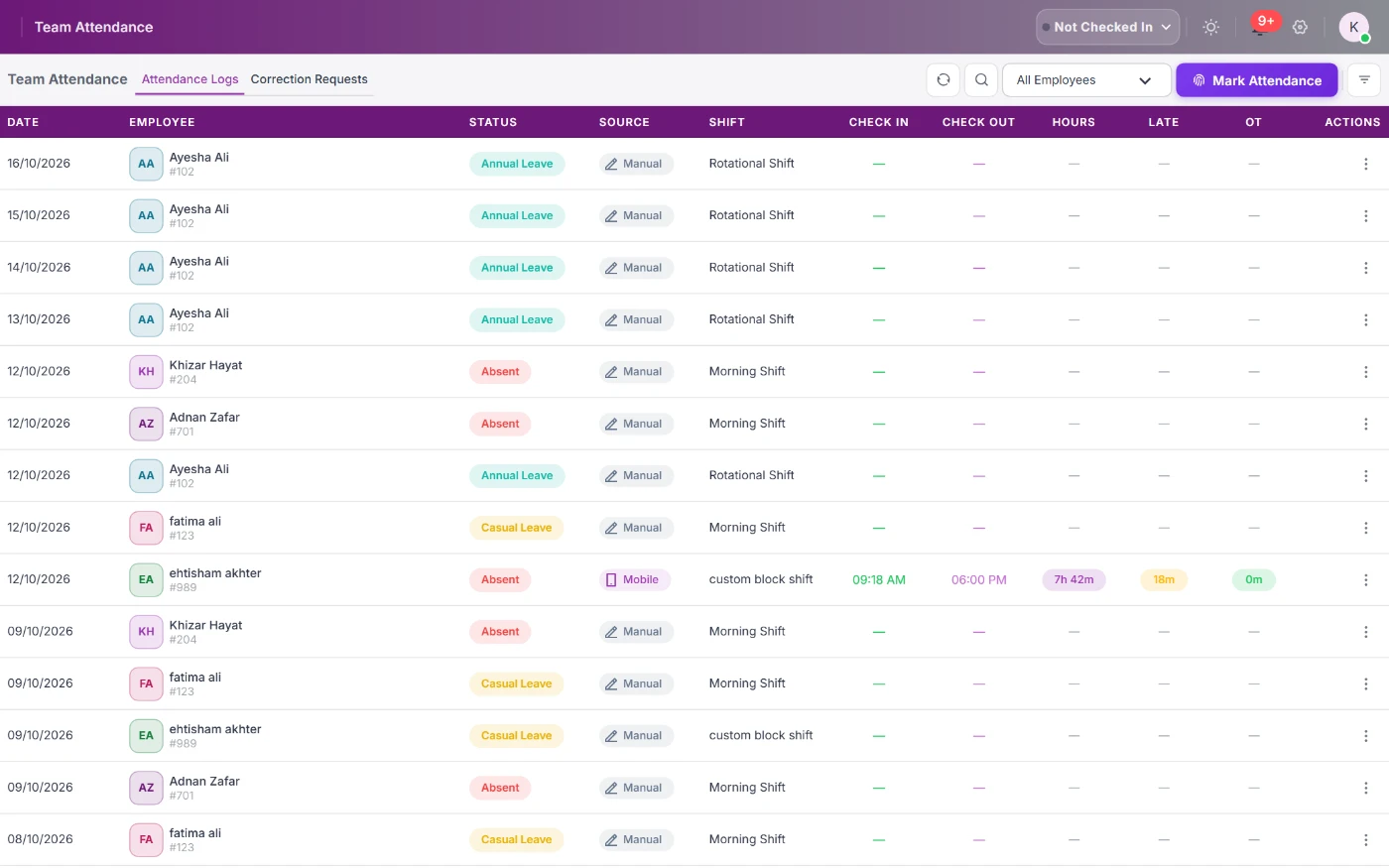
A dealership is three clocks in one building if it runs sales, a workshop and a parts counter. The technician is not on the assembly shift. The parts counter is not on the service bay's hours. Putting all three through one office punch, or through none, is how the month drifts. The workshop can keep its own device. Counter staff can use the browser. A person who starts at a customer's site, or at a warehouse that is not the showroom, can use the phone. GPS check-in is on Starter. The GPS attendance app records the check-in inside the work location you set. It is not a workshop-management product, and it does not replace the job card. All three methods write to the same attendance sheet, which is the sheet payroll uses.
Tyre and battery distributors are the warehouse half of the same month. Their people start at a store or on a delivery round, not on a production line. A check-in on the phone, inside the location you set, is how that day reaches payroll. The employee app is also where the payslip, the leave balance and a shift-change request sit. Workshop staff rarely queue at an HR desk at a head office in another city. Putting the slip on the phone cuts that queue. The mobile app is on Starter. Employee self-service describes it. A retail counter with several outlets, where the product is not a vehicle, is retail HR software. This page stays with the automotive workforce.
Contract labour, EOBI and the city of the plant
Contract labour is common on a line, in a yard and in a workshop that adds people for a model change or a busy service month. Whether people employed through another person count for EOBI coverage is the question the manufacturing HR software page takes from section 1(4) of the EOBI Act 1976. This page does not reprint the section. The practical point for payroll is that a contractor's crew and the company's own crew should not be pasted into one workbook with one set of rules if their employers, their attendance and their wage are different. StreamHCM keeps an employment type so the rules can differ, on the record of the employer who pays the person. Adding a joiner directly to the employee list does not wait for the recruitment module. Final settlement, when the contract ends, uses the same attendance the wages were paid from. That settlement tool is marked on Enterprise. Read the plan list on pricing before you promise it on a smaller subscription.
EOBI is federal. The contribution page on eobi.gov.pk states that the employer pays 5% of the minimum wage and the employee pays 1% of the minimum wage, per insured person, not a percentage of each person's actual salary and not a percentage of a piece-rate, incentive or commission total. EOBI Circular No. 01/2026-27, dated 20 August 2026, applied the Islamabad Capital Territory minimum wage of Rs 40,700 from 1 July 2026. Five percent of that base is Rs 2,035 and one percent is Rs 407, due by the 15th of the following month. The EOBI contribution guide is the longer note, and the EOBI calculator checks one person. Only the employee share is deducted from wages. The employer share is your cost. The part being made does not change the base.
Provincial social security follows the site, not the brand. A plant or a workshop in Punjab configures PESSI. A plant or a workshop in Sindh configures SESSI. A site in Balochistan configures BESSI. A site in Khyber Pakhtunkhwa configures KP ESSI. PESSI's own overview states an employer contribution of 6% of wages, and the employer may not recover that share from the worker. The wage ceiling is a payroll setting. The PESSI contribution guide records the February 2026 ceiling. This page does not restate that cap. The SESSI contribution guide is the Sindh note. Do not copy one province's scheme onto every branch because the head office sits in that province. The social-security line on the payslip is marked on Enterprise, while the payroll module itself starts on Growth. Confirm both on pricing before you assume a Growth subscription already calculates the provincial line. FBR salary tax under Section 149 is withheld from the annualised salary. This page does not reprint the slabs. Use the salary tax guide and the tax slab calculator.
Karachi, Lahore, Sheikhupura and Gujranwala
Organisation management holds companies, branches and departments. A single plant can be one branch: the line, the stores and the office as departments, with one device list and one holiday calendar. A group that also runs a vendor shop, a second-city assembly plant, a dealership or a warehouse needs those as their own branches, because the devices, the public holidays and the provincial scheme do not travel with the part. On the published plans, Starter, Growth and Enterprise each include one branch. Premium is quoted with custom branches. That is the fit when the group has more than one site. The limit is on the pricing page. Do not assume a Starter account can hold a Karachi plant and a Lahore workshop as two statutory branches.
The policy's review of the 2007-12 programme says cluster development in Karachi and Lahore was among the schemes it treats as implemented. This page does not add a 2026 count of units in either city, and it does not treat that sentence as a list of customers. A Karachi plant is a Sindh branch: SESSI and the Sindh wage check, on the Karachi page. A Lahore plant or dealership is a Punjab branch: PESSI and the Punjab wage check, on the Lahore page. Sheikhupura, on the M-2, and Gujranwala, where light engineering and piece-rated workshops are the local pattern, are the other Punjab pages. A tractor plant counted as one line on the Dera Ghazi Khan profile is a further Punjab branch, not a second copy of the Karachi file.
Multi-branch HR software is the note on running more than one site once the plan allows it. Organisation management is the module. Reports can still split cost by department inside the one branch a smaller workshop uses. The employee record holds the CNIC, the appointment letter and the branch. Employee management is the records page. Documents, where you keep the copies you collect, are on Growth. Holidays can differ by branch. A Sindh public holiday stays on the Karachi calendar even when a Punjab workshop of the same group does not observe it.
Safety courses on the employee record
The policy's safety chapter is about vehicles. It points to WP-29 regulations and to standards for the product, including electric two- and three-wheelers. That is not an employee training register, and this page does not turn it into a required number of training hours. A plant or a workshop that wants a record of who attended a safety course the employer itself assigned needs a different file: the person's name, the course, and the date, sitting with the employee rather than in a folder nobody opens at payroll.
StreamHCM's training module keeps courses, learning paths and exams inside the same account, and it stores a certification from a completed course on the employee profile. That is a record the employer chooses to keep. It is not a claim that the module replaces a statutory inspection file, and it is not a count of courses the law requires. The module page is training and LMS. Appointment letters and the copies you already collect can sit in the document vault, which is on Growth. Employee management is the record those documents hang from.
Getting started
StreamHCM's team is in Lahore, at 68 MB, Zainab Tower, Model Town, Link Road. There is no requirement to visit the plant or the workshop. Setup is remote: import the employee list, connect the device at one gate, map the shifts that actually run, and run a parallel payroll beside the current sheet. Devices at the gate store punches and send them when the connection returns, so a short outage does not wipe the day. Nothing is installed on a server at the site.
Every plan includes a 14-day free trial. No card is taken on this site. Start with one site and one crew, usually the line or the workshop, where the register and the paysheet disagree most often. Compare attendance, any approved overtime, a piece, incentive or commission line, EOBI, and the provincial social security line before you add the next site. Request the trial from the contact page, or read pricing for the PKR plans and features for the full module list.
Frequently asked questions
Manufacturing HR software is the factory pattern for a plant gate and a production crew, including engineering that is not automotive. This page is the automotive case: parts vendors, assembly, motorcycles and rickshaws, tractor plants, dealership workshops, and tyre or battery distributors.
No. The Auto Industry Development and Export Policy 2021-26 states capacity targets of 650,000 cars, LCVs and SUVs, 100,000 tractors, 20,000 heavy commercial vehicles and 7 million two- and three-wheelers a year. Those are targets in the policy. They are not a count of employees, plants or customers, and they are not this year's production.
Yes. Approved quantities, days and amounts for the period can be added as salary components beside time-based pay. You review the total against the provincial minimum wage you have configured. StreamHCM does not replace the job card or the sheet that counts pieces.
Yes. Night shift is a shift type, and a shift that crosses midnight stays one attendance day. You define the start, the end and the grace minutes. A dealership workshop can keep a different roster on its own branch.
Yes. EOBI is federal and applies across the company on the wage base in the EOBI guide. PESSI attaches to a Punjab branch and SESSI to a Sindh branch, so the two sites are not forced onto one provincial rule in the same payroll run. On the published plans, Starter, Growth and Enterprise each include one branch. Premium is quoted with custom branches.
No. The policy's WP-29 notes are about the vehicle, not about an employee course. The training module can store a course and a certification on the employee profile when the employer assigns one. It is not a statutory inspection file, and this page does not invent a required number of training hours.
No. The team is based in Lahore and supports automotive customers remotely. The software is cloud-based. The 14-day trial does not take a card on this site.
Sources
- Ministry of Industries and Production: Auto Industry Development and Export Policy 2021-26 (capacity targets, supplier tiers, tractors and two- and three-wheelers)moip.gov.pk
- Engineering Development Board: automotive sector functions, manufacturing certificates and local partsengineeringpakistan.com
- EOBI: contribution rates (eobi.gov.pk)eobi.gov.pk
- EOBI Act 1976 (OPHRD PDF), section 1(4), as discussed on the manufacturing pageophrd.gov.pk
- FBR Withholding Tax Rate Card, Tax Year 2027 (Section 149)download1.fbr.gov.pk
- PESSI overview: 6% employer contribution (pessi.punjab.gov.pk)pessi.punjab.gov.pk
See StreamHCM running your HR
Request a 14-day trial. No card is taken on this site.