
Last updated Nov 2026
Quick answerTurnover rate = leavers ÷ average headcount × 100. Average headcount = (opening + closing) / 2. A year of 120 opening, 130 closing and 15 leavers is 12.00% turnover and 87.50% retention. The formulas are standard HR formulas. This page does not publish an industry benchmark.
Turnover from headcount and leavers
Opens on a year with 120 people at the start, 130 at the end and 15 leavers.
People employed at the start of the period. Must be more than 0.
People employed at the end of the period. Zero is allowed.
People who left the company in the period. Transfers between branches stay in headcount.
Optional. Resignations only. Leave blank if you do not split them. Cannot exceed total leavers.
Optional. If blank, hires are closing − opening + leavers.
Worked example
- Average headcount125
- Leavers15
- New hires (derived)25
- Retention87.50%
- 1Average headcount = (opening + closing) / 2
- 2Turnover = leavers / average × 100
- 3Hires, if blank = closing − opening + leavers
- 4Retention = (closing − hires) / opening × 100
What turnover and attrition mean here
A leaver is someone who stopped being employed by the company during the period. The reason can be a resignation, the end of a contract, or a dismissal. HR teams in Pakistan often say turnover and attrition as if they were different statistics. In practice the spreadsheet usually has one column of exits. This calculator uses that column. It does not invent a second definition, and it does not tell you whether 12% is high or low. There is no Pakistani benchmark on this page, and no claim that replacing a person costs a set share of salary.
Retention, on this page, is a different question: of the people who were here at the start, how many are still here at the end? New hires who joined and stayed are in the closing headcount, but they were not part of the opening staff, so they are taken out before the retention rate is worked. That is why retention is not simply 100 minus turnover.
The formula, with the year the calculator opens on
| Step | Formula | Year example |
|---|---|---|
| Average headcount | (opening + closing) / 2 | (120 + 130) / 2 = 125 |
| Turnover | leavers / average × 100 | 15 / 125 × 100 = 12.00% |
| Hires, if you leave the box blank | closing − opening + leavers | 130 − 120 + 15 = 25 |
| Retention | (closing − hires) / opening × 100 | (130 − 25) / 120 = 87.50% |
Display is rounded to two decimal places. The division itself is not rounded early, which is why 3 leavers and an average of 49 is 6.12% for the month, not 6.1%. If you type voluntary leavers, involuntary leavers are the rest. In the month example, 2 of 3 leavers are voluntary: 4.08% voluntary and 2.04% involuntary on an average of 49.
A month and a quarter, and why annualising exaggerates
Month: opening 48, closing 50, leavers 3, voluntary 2. Hires come out as 5. Average headcount is 49. Turnover for that month is 6.12%. Annualised, that is 6.12% × 12 = 73.47%. Retention is (50 − 5) / 48 = 93.75%. The 73.47% is what the year would look like if every month matched this one. It is not evidence that the year will. Use it to compare a short period with an annual target you already have. Do not paste it into a board pack as the year's attrition.
Quarter: opening 300, closing 280, leavers 35. Hires are 15. Average headcount is 290. Turnover for the quarter is 12.07%. Annualised, 12.07% × 12 / 3 = 48.28%. Retention is (280 − 15) / 300 = 88.33%. A quarter already smooths one bad week. A month does not.
Voluntary, involuntary, and people who leave in the first year
If you know which leavers resigned, type that count. The rest are treated as involuntary for the split only. The calculator does not decide whether a dismissal was fair. That is a different record, including a performance improvement plan where one was used, and the notice period that applied.
Early leaving is a subset you can count yourself: first-year leavers divided by all leavers, or divided by the people who joined in that year. This page does not ship a benchmark for that ratio. If you want the rate, use the same shape as turnover: that group of leavers, divided by the average headcount you choose to put under them, times 100. Say which denominator you used. A rate with no denominator cannot be compared with next quarter.
Where the numbers come from
You need three counts: who was employed on the first day, who was employed on the last day, and who left in between. StreamHCM's reports screen lists a Headcount Report, a New Joiners Report and a Separation Report under HR Reports. Those three reports are the inputs. Finance Reports on the same screen include the Employee Loan Ledger and the Employee Advance Ledger, which matter at exit, not in the turnover percentage.
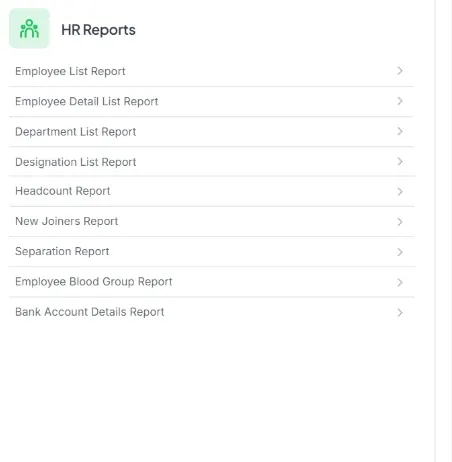
The trend view that sits next to those reports is reports and analytics. Call-centre floors talk about attrition because the roster turns over inside a quarter. The industry page is HR software for call centres. Security companies with guards moving between client sites have the same counting problem, with an extra rule: a move between your own sites is not a leaver. See HR software for security companies.
What to do with the rate
A rate is a prompt, not a verdict. If voluntary leavers are most of the exits, the next conversation is why people resigned. Exit interviews belong in offboarding, on employee separation and offboarding. The money side of that exit, including an outstanding loan, is the final settlement calculator. If the same roles fail a standard before anyone resigns, the written plan is the performance improvement page linked above. How a team talks about standards before anyone is on a plan is building a performance culture.
Do not annualise one bad month and then set a target off that number. Do not count a branch transfer as a resignation. Do not treat retention and turnover as the same percentage written two ways.
Turnover questions
Divide the number of people who left in the period by the average headcount, then multiply by 100. Average headcount is opening headcount plus closing headcount, divided by 2. A year that starts at 120, ends at 130 and loses 15 people has an average of 125 and a turnover of 12.00%.
People use the two words for the same leavers. Turnover on this page is every exit in the period, divided by average headcount. Attrition is often used for the same rate, and sometimes only for people who are not replaced. This calculator does not assume a replacement. It shows the rate, and a separate retention figure for the opening staff who are still there.
Multiply the month's turnover rate by 12. A month at 6.12% annualises to 73.47%. That is a projection, not a forecast. One bad month, stretched across a year, will look worse than a year that already contains quieter months. Hide the annualised line when the period is already 12 months.
No. Count only exits from the company. A transfer between branches stays in headcount. If the closing figure drops because of a transfer you have not recorded as a hire at the other branch, the headcount will not reconcile and the calculator asks you to check it.
On this page it is the share of the opening staff still employed at the end: (closing headcount − new hires) / opening headcount. In the year example, hires are 25, so retention is (130 − 25) / 120, which is 87.50%. It is not 100% minus the turnover rate. Those two figures answer different questions.
Run this in live payroll, not a spreadsheet
StreamHCM applies the same FBR slabs, attendance rules, EOBI and expense-claim logic across every employee, then generates the payslip. The same rules sit inside HR software in Pakistan.