
Types of HR letters in Pakistan (2026 guide)

Written and reviewed by the StreamHCM HR & Payroll Team. Last updated 13 November 2026. Published 10 November 2026.
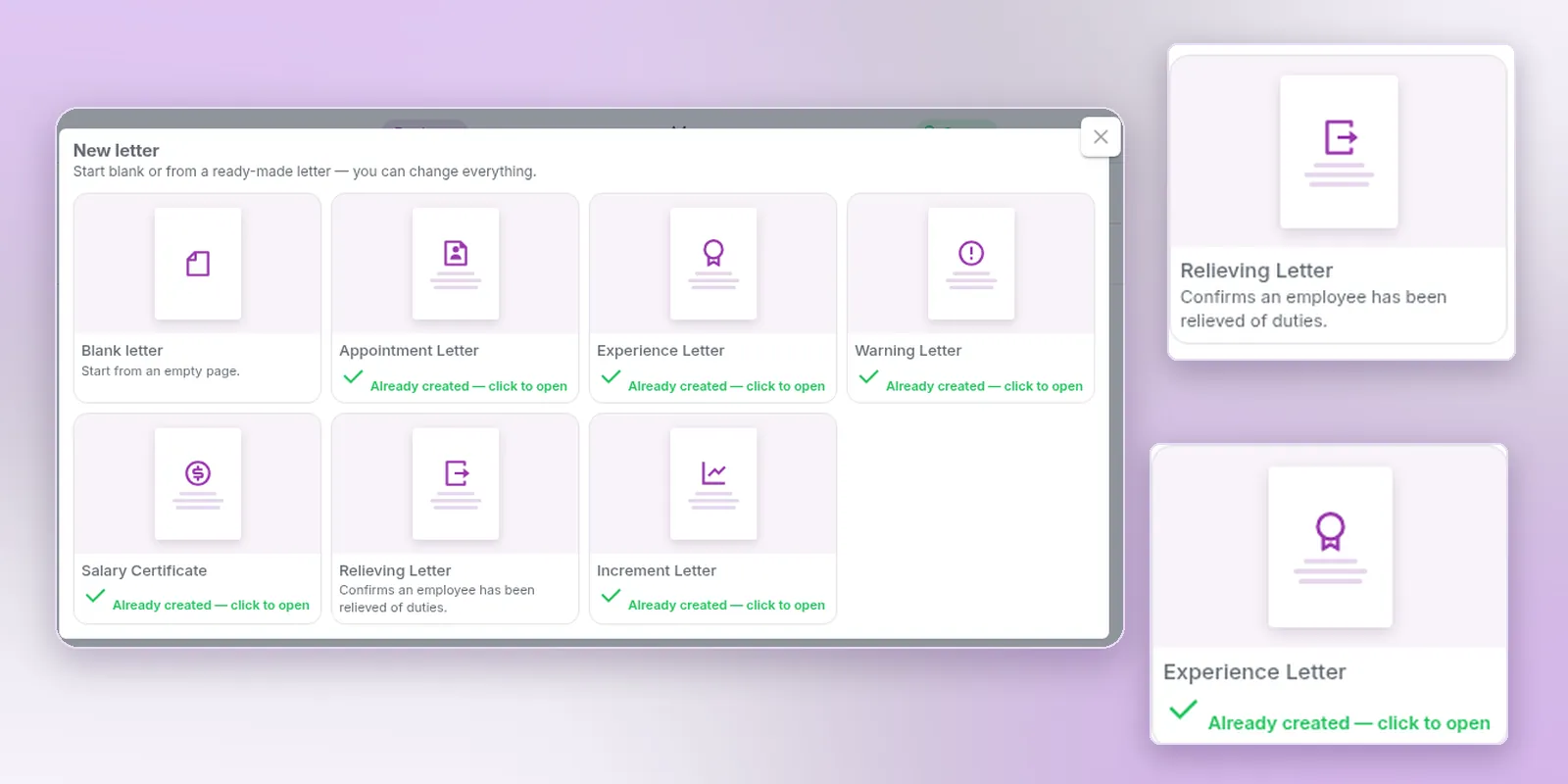
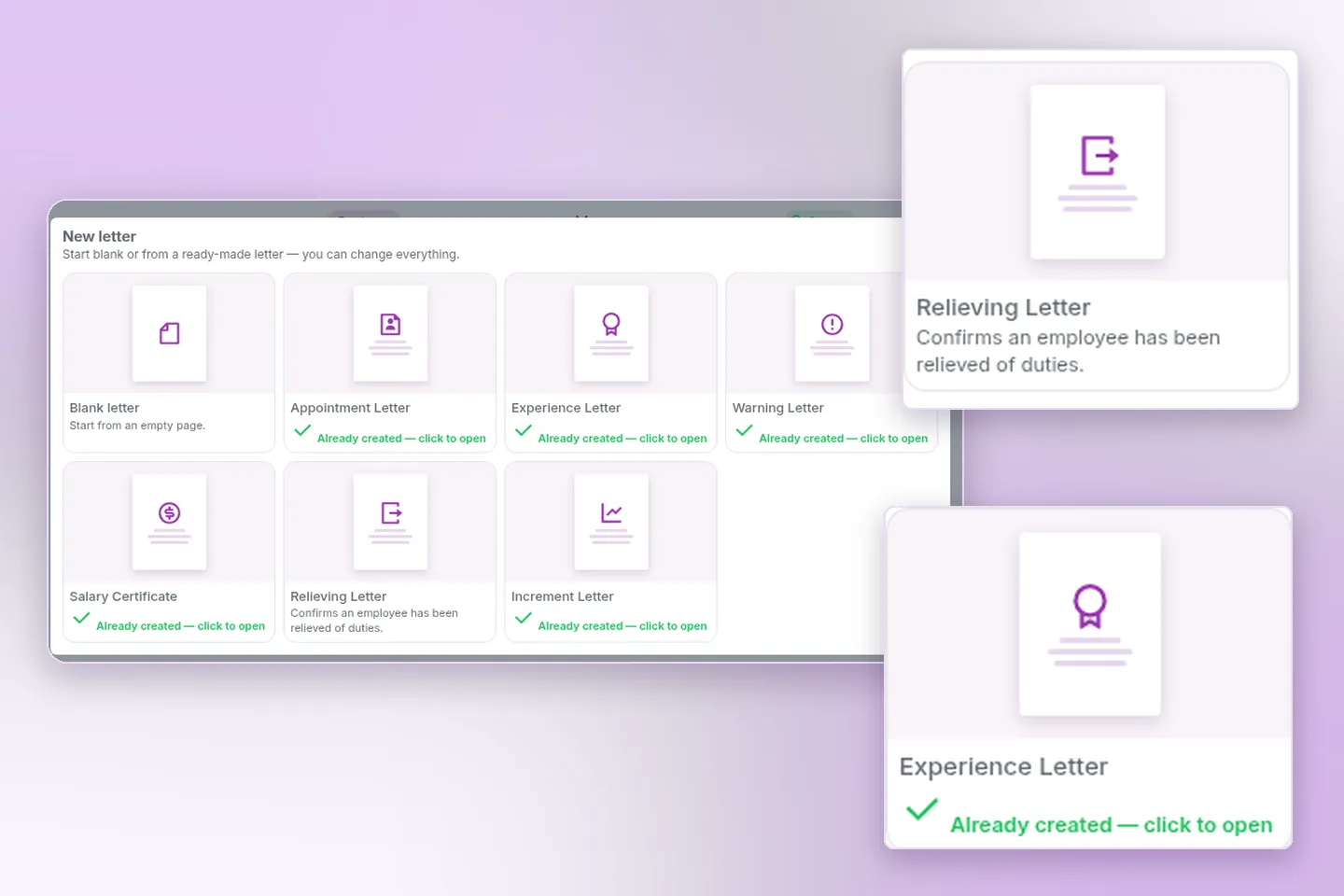
Most Pakistani HR files come back to seven letters: offer, appointment, experience, warning, salary certificate, relieving and increment. Write each wording once, on letterhead, with a date, a reference and a signatory. Fill the person's name, CNIC, father's name, role, salary and dates from the employee record instead of retyping them. The statute does not give every one of these letters a form. Where it does, follow the linked guide.
HR does not run out of letters because the law invented a new one. It runs out of letters because the same Word file is copied, and last month's CNIC is still in the paragraph. This guide says what each letter is for, what should be on it, and which existing StreamHCM page already quotes the rule. It is general information as of November 2026, not legal advice. Provincial standing orders differ. Confirm the statute that covers your establishment before you treat a letter as the legal record.
Offer letter
Use it when a candidate is selected and has not joined. It should name the role, the department, the salary you are offering, the joining date, the location, the employment type and the probation you intend to apply. The company name, the date and a reference belong on it too.
In StreamHCM the offer letter is the one wording sent with every offer. You can replace that wording, and you can put the standard wording back. Sending an offer emails the candidate a link. The page they open shows your offer letter. The email does not attach the letter as a PDF, and accepting the offer on that page is not an e-signature.
Appointment letter
Use it for the written terms of the job: who the employer is, who the employee is, the designation, the place of work, the pay, the hours, the leave and the notice. For a workman covered by the Standing Orders, the letter should also say the worker category and the probation. The appointment letter guide is the checklist, including the three-month probation point and why a single gross figure makes later calculations harder. Probation and notice are separate pages because those clauses get argued on their own.
A transfer or a promotion needs its own short letter. Do not rely on the joining letter to describe a job the person left two years ago.
Experience letter
Use it when a new employer, a bank or the employee asks for proof of the job, and when you are closing the file. Say the legal name of the company, the person's name as it is on the record, the designation, the department, the joining date and the last working day, then one factual line about the work. Say how the employment ended, in neutral words. Sign it.
Standing Order 19 is narrower than that practice. The experience letter guide quotes it: a permanent workman is entitled to a service certificate at dismissal, discharge, retrenchment or retirement. Resignation is not in that sentence. Many employers still issue an experience letter on resignation because the next employer asks. If you are issuing the statutory certificate, say so in the heading. Leave salary off this letter. Pay belongs on a salary certificate or the payslip. CNIC is optional. The guide prefers to leave it off unless the employee asked for that copy.
Warning letter
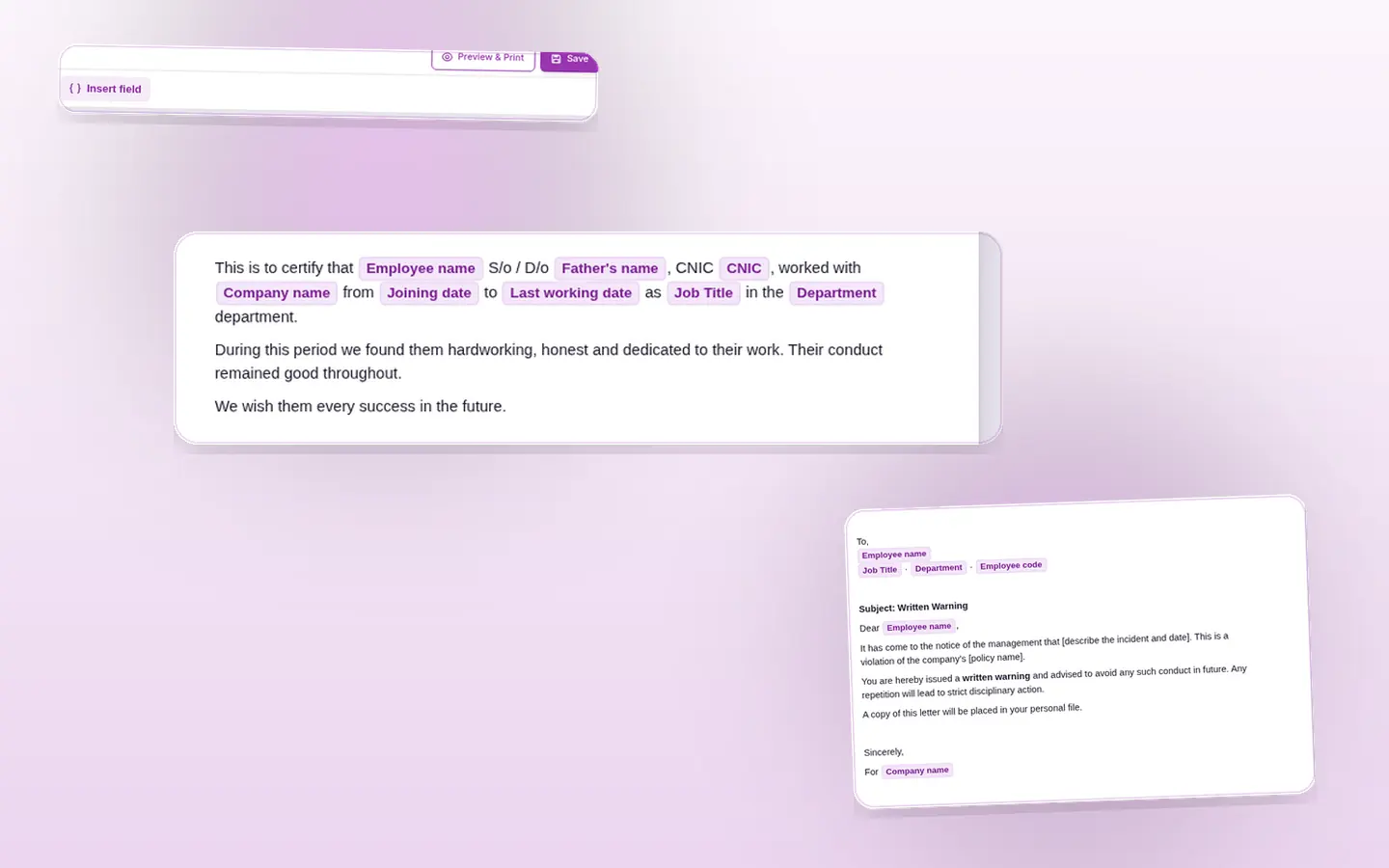
Use it when conduct or a missed standard has to be on the file, and a conversation is not enough. Name the person, the role, the department and the employee code. State the incident and the date, the rule, that this is a written warning, and what a repeat will lead to. Leave a line for the employee to acknowledge receipt. Signing that line is not an admission.
A warning is not the whole misconduct process. Where the Standing Orders apply, dismissal for misconduct still needs a written charge, a chance to explain, and an inquiry where the law requires one. The warning letter guide is that sequence. Do not hide a dismissal inside a polite experience letter later.
Salary certificate
Use it when someone needs a letter that states current gross salary, commonly for a bank, a landlord or a visa file. Put the person's name, the designation, the gross salary and the date. Sign it on letterhead. A copy-ready layout, and how to issue it from the employee record, is the salary certificate format.
It is not the payslip, and it is not the salary tax certificate. The payslip format is on the salary slip page. Tax withheld under Section 149, and the certificate the employee needs for the return, is the salary tax certificate guide. This site does not have a separate statute page for a salary certificate, because the request usually comes from the bank rather than from a standing order.
Relieving letter
Use it when the person has handed over and been relieved of duties on a stated last working day. It confirms that the duties ended. It does not calculate unpaid salary, leave encashment or notice pay. Those sit on the final settlement. The Ordinance text checked for the experience letter guide does not use the name “relieving letter”. Treat it as a company closing letter, filed next to the experience letter, not as a substitute for wages. The fields and a copy-ready template are on the relieving letter page.
Increment letter
Use it when pay changes and you want the employee to have the new amount and the date it starts. Say the old and new figures if that is your practice, the designation, and the effective date. In the StreamHCM template the effective date is typed. It does not fill itself from the payroll screen. This page does not claim that Pakistani law requires a particular increment-letter form.
A blank letter
Use it when none of the seven fit: a posting order, a confirmation after probation, a certificate a school or a hospital has asked for in its own words. Copies of an official letter can be saved as custom letters. Keep one official version of each standard type so the company is not running three different warning wordings.
What every letter should carry
- Company letterhead, or a header picture that is the same on every page.
- City, date and a reference. Issued letters in StreamHCM get a reference such as HR/2026/0007.
- The person's name as it is stored, not a shortened name from a chat.
- A signatory with a name and a designation. An unsigned page is hard for the next reader to rely on.
- A copy kept with the employee, not only in the printer tray.
Fields the product can fill from the record include father's name, employee code, CNIC, job title, department, branch, joining date, last working date, gross salary, and the company name, address, phone and email. Use the ones that letter needs. Do not print CNIC and salary on a letter that only had to prove the dates.
How the template saves the retyping
The slow part is not the compliment in the last paragraph. It is the CNIC, the father's name and the joining date, copied from a spreadsheet that does not match the payroll record. In the HR letter generator those values are merge fields. You insert them once. At issue time they are replaced from the employee, or from the offer, and you read the filled page before you print.
Issue and Print is on the employee profile, under Actions, and on the employees list. The issued copy stays on that person with the reference and the date, so a later print does not depend on finding the Word file. Header and footer images are your logo or a full-width letterhead, not a generic PDF frame.
What this does not do
- It does not draft the letter with AI. You edit the wording.
- It does not collect an electronic signature. The signatory line is for a pen, or for you to print and sign.
- It does not email an issued experience, warning, relieving or salary letter. You print it, or you save a PDF from the browser and send that yourself.
- It does not replace the show-cause or the final settlement. Those are different records. Final settlement is the money. The letter is the employment fact.
Only a letter saved on the server can be issued. A letter that is still only on that browser cannot.
FAQ
Which HR letters do employers in Pakistan usually issue?
Offer, appointment, experience, warning, salary certificate, relieving and increment letters cover most of the file. A blank letter is for the wording that does not fit those seven. The law does not use all of these names. Appointment, experience and warning have their own guides where a statute is quoted.
Is an experience letter the same as a service certificate?
Not always. Standing Order 19 of the 1968 Ordinance entitles a permanent workman to a service certificate at dismissal, discharge, retrenchment or retirement. An experience letter is the wider company letter, including when someone resigns. The experience letter guide sets out the difference.
What should a warning letter include?
The incident and the date, the rule or policy, the warning itself, what happens if it is repeated, and a line for the employee to acknowledge receipt. Acknowledgement is not an admission. Misconduct that could lead to dismissal still needs the show-cause steps in the warning letter guide.
Is a salary certificate the same as a salary tax certificate?
No. A salary certificate states current gross pay, often for a bank or a visa file. A salary tax certificate is the employer's certificate of tax withheld. The payslip is a third document. Keep them separate.
Can StreamHCM email or e-sign these letters?
No. Issued letters are previewed and printed. Print / Save as PDF uses the browser print dialog. There is no e-sign, and the issue flow does not email the letter. An offer email sends a link to a page that shows the offer letter. That is not an emailed PDF and not a digital signature.
Does AI draft the letter?
No. You edit ready-made wording, or start from a blank page. Merge fields fill the employee and company details when the letter is issued. Rehbar AI does not write the letter.
Related: HR letter generator, appointment letter, experience letter, warning letter, notice period, salary slip, salary tax certificate.
Issue the letter from the employee record
Keep one wording for each letter type, and fill the person's details when you print. 14-day free trial.