
Final settlement calculation in Pakistan 2026

Written by the StreamHCM team for HR and payroll managers in Pakistan. Updated on 30 October 2026.

A final settlement in Pakistan is the last payment an employer owes a departing employee. It usually adds up unpaid salary for days worked, encashment of unused annual leave, gratuity or provident fund dues (where applicable), any notice pay owed, and pending allowances or bonuses — then subtracts advances, loans, notice shortfall and income tax. Most companies aim to clear it within the period set by law or contract, typically within days of the last working day for workers covered by labour law.
The figures in this guide are general guidance for HR teams. Confirm them against the Standing Orders Ordinance 1968, the provincial labour law that applies to your establishment, and the employee's contract before you pay.
When an employee resigns, retires or is let go, the final settlement is the moment of truth for an HR team. Get it right and the employee leaves with a good word for your company. Get it wrong and you face disputes, labour court complaints and a bad Glassdoor review. This guide walks through each component, a worked example in PKR, and a checklist you can use from next month.
What is included in a full and final settlement?
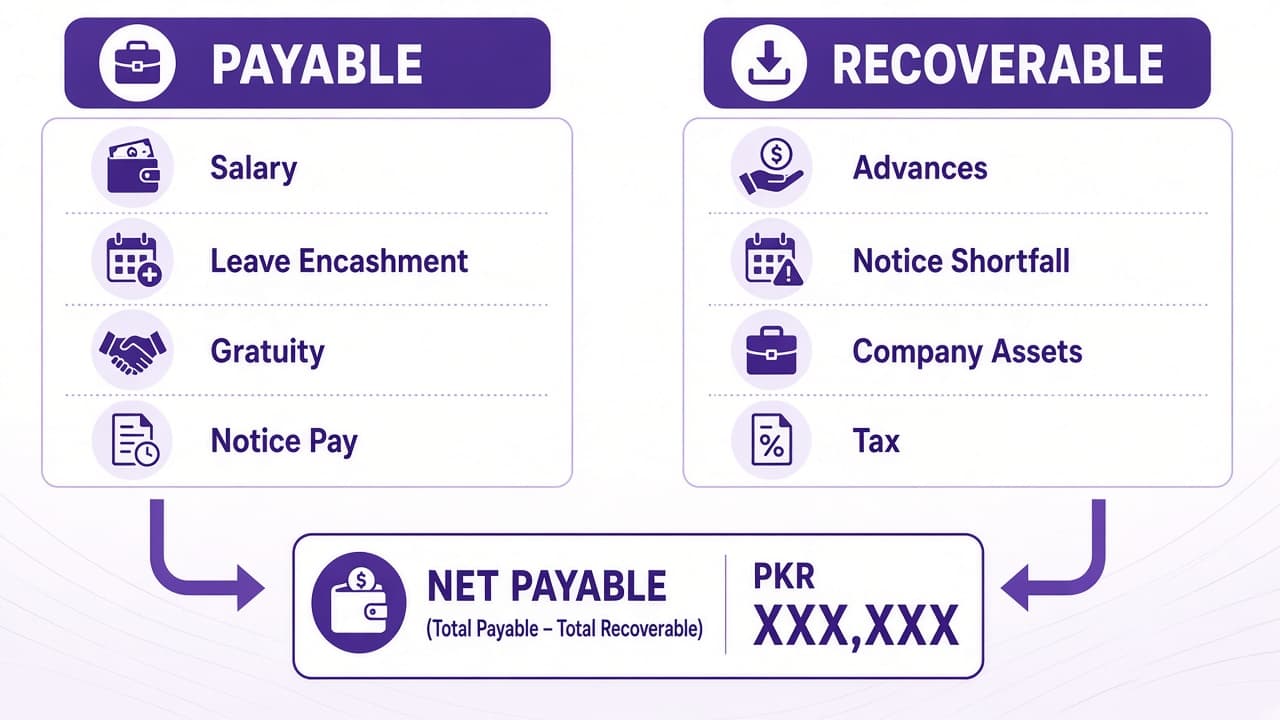
Think of the settlement as two columns: what you owe, and what the employee owes you.
Amounts payable to the employee
- Salary for days worked in the final month, pro-rated on the basis your policy uses (calendar days or 30-day month).
- Leave encashment for earned annual leave that has not been availed, where your policy or law allows it.
- Gratuity — for permanent workers in establishments covered by the Standing Orders law, typically 30 days' wages for every completed year of service (and a part year above six months), unless an approved provident fund scheme replaces it. Many companies also have contractual gratuity for staff not covered by the law.
- Provident fund balance (employee + employer share plus profit), paid by the fund trustees according to its rules.
- Notice pay, if the employer ended the job without giving the contractual notice.
- Pending reimbursements, overtime, commissions and pro-rated bonus, if your policy provides for them.
Amounts recoverable from the employee
- Unadjusted salary advances and loans.
- Notice-period shortfall, if the employee left without serving notice and the contract allows recovery.
- Company assets not returned (laptop, phone, SIM), valued per policy.
- Income tax withheld on the final payment under FBR salary slabs, and the employee's share of EOBI/social security for the last month.
Step-by-step: how to calculate final settlement
Step 1: Fix the last working day
Everything depends on this date: days payable, completed service years, leave accrual and the month of tax deduction. Confirm it in writing with the line manager.
Step 2: Calculate pro-rated salary
Gross monthly salary ÷ days in month (or 30) × days worked. Include fixed allowances (house rent, conveyance, medical) on the same basis.
Step 3: Work out leave encashment
Take the leave balance on the last working day (annual leave only — casual and sick leave are usually not encashable unless your policy says so). Multiply by the per-day rate, normally basic salary ÷ 30 or gross ÷ 30 depending on your policy. Write the basis into your leave policy so it is never argued.
Step 4: Calculate gratuity (if applicable)
Last drawn wage (basic, or as policy defines) × completed years of service, using 30 days' wages per year as the common legal baseline. Service of more than six months in the final year is usually rounded up to a full year.
Step 5: Add notice pay or deduct notice shortfall
Compare the notice given with the notice required in the contract. The difference, in days, is paid or recovered at the daily rate.
Step 6: Subtract recoveries
Advances, loans, unreturned assets. Keep signed acknowledgements for each.
Step 7: Compute tax
Lump-sum amounts change the employee's annual taxable income. Recompute the year's tax on projected annual income including the settlement and withhold the difference, rather than taxing the final month as if it were a normal one. Issue a salary tax certificate with the payment.
Step 8: Get sign-off and pay
Finance approves, the employee signs a settlement statement, and payment goes through the bank — never cash for large amounts.
Worked example (PKR)
Ayesha, an accounts officer in Lahore, resigns after 4 years and 8 months. Her last working day is 20 October.
| Item | Basis | Amount (PKR) |
|---|---|---|
| Gross salary | 150,000 / month (basic 100,000) | — |
| Salary for 20 days | 150,000 ÷ 31 × 20 | 96,774 |
| Leave encashment | 12 days × (100,000 ÷ 30) | 40,000 |
| Gratuity | 5 years (4y 8m rounds up) × 100,000 | 500,000 |
| Notice | Served full 30 days | 0 |
| Gross payable | 636,774 | |
| Less: salary advance | (25,000) | |
| Less: laptop not returned | none | 0 |
| Less: income tax (recomputed) | per FBR slabs | as calculated |
| Net payable | 611,774 minus tax |
Illustrative only. Your gratuity and encashment basis depends on your policy and the law that applies to your establishment. Replay the full exit in the final settlement calculator. The gratuity rule on its own is in gratuity in Pakistan and the gratuity calculator.
Common mistakes Pakistani HR teams make
- Using different per-day rates for salary, leave and notice in the same settlement. Pick one basis per component and document it.
- Forgetting leave accrued in the final month. Accrual runs up to the last working day.
- Paying gratuity and employer PF both when the PF scheme was meant to replace gratuity — or paying neither.
- Taxing the lump sum flatly instead of recomputing annual tax, which over- or under-deducts.
- Delaying settlement until every asset is returned. Clear what is undisputed and document the rest.
- Spreadsheet errors. One wrong cell reference in an Excel template can cost tens of thousands of rupees and an employee's trust.
Final settlement checklist
- Resignation/termination letter and last working day on file
- Clearance from IT, admin, finance and line manager
- Attendance and leave balance frozen on last day
- Gratuity / PF eligibility confirmed
- Advances and loans reconciled
- Tax recomputed and certificate generated
- Settlement statement signed by employee
- Payment made by bank transfer; experience letter issued
How HR software makes final settlement painless
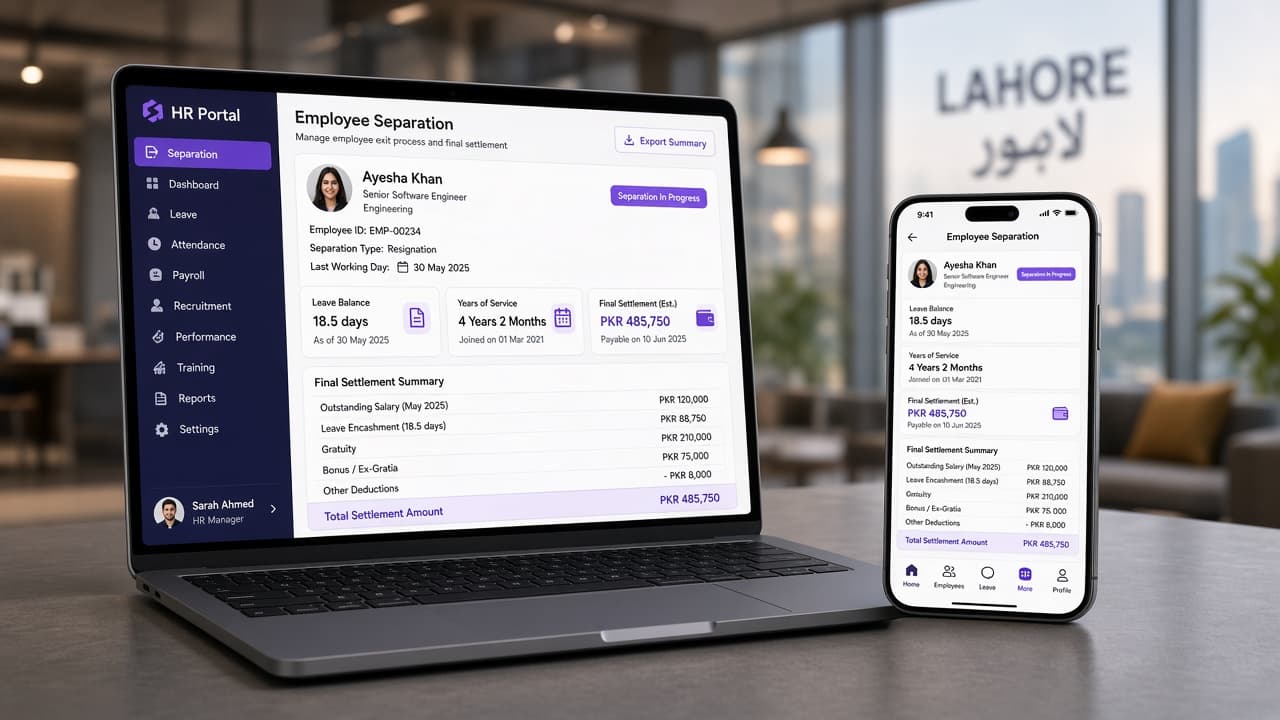
Most settlement errors come from data spread across attendance sheets, leave registers and payroll files. In StreamHCM, attendance, leave balances, loans and payroll sit on one employee record, so when you mark an employee as separated the system already knows the days worked, unused leave, service length and outstanding advances. HR reviews a pre-filled settlement instead of rebuilding it in Excel, and the payslip, tax deduction and experience letter come from the same data.
You can try the numbers yourself with the final settlement calculator, the salary tax calculator and the payroll calculator, or read our guides on provident fund in Pakistan, overtime calculation rules and EOBI contributions. When the question is the pay run itself, see payroll software for Pakistan.
FAQ
How long does an employer have to pay a final settlement in Pakistan?
For workers covered by labour law, dues are generally expected within a short statutory window after the last working day (often cited as within two working days of termination under the Standing Orders). For managerial staff, the contract usually governs; 30 days is a common company policy.
Is gratuity mandatory in Pakistan?
For permanent workers in establishments covered by the Standing Orders law, gratuity is due unless the employer runs an approved provident fund scheme in its place. Outside that scope it depends on the employment contract.
Is leave encashment taxable?
Yes. Leave encashment is part of salary income and is taxed under the FBR salary slabs for that tax year.
Can an employer deduct notice period from final settlement?
If the contract requires notice and the employee did not serve it, the employer can usually recover pay in lieu of the shortfall, as long as the clause is in the contract.
Can final settlement be withheld until company assets are returned?
Employers may recover the documented value of unreturned assets, but withholding the entire settlement indefinitely invites disputes. Pay undisputed amounts and settle the rest separately.
Does StreamHCM calculate final settlement automatically?
StreamHCM pulls days worked, leave balance, service length and loan balances into the separated employee's final payroll, so HR only reviews and approves.
Ready to put this into practice?
See how StreamHCM keeps attendance, leave, loans and the last payslip on one employee record.