
Employee loans and salary advances in Pakistan: tax, deduction limits and a policy that works

Written and reviewed by the StreamHCM HR & Payroll Team. Last updated 11 November 2026.

An employer in Pakistan can lend to staff and recover instalments through payroll, because the wages laws allow deductions for recovery of advances. If the loan is interest-free or below 10% a year and exceeds Rs 1 million, the benefit is taxable salary under section 13(7) of the Income Tax Ordinance. A waived loan is taxable in full (s.13(9)).
As of November 2026. This page is general information based on the Payment of Wages Act 1936 as published for Punjab, the Income Tax Ordinance 2001 as amended up to 20 February 2026, and the Punjab Labour Code 2026. It is not legal or tax advice. Your province's law, standing orders and contract may differ. The Punjab Labour Code points apply only once that Code commences.
A loan and an advance are not the same line on a payslip
An advance is part of wages paid early. The person has earned, or is about to earn, a salary, and the employer pays some of it before the normal pay date. Recovery is usually from the next salary, or from the next few salaries. A loan is a larger sum, recovered over months, usually under a written agreement that states the amount, the instalment and what happens if the person leaves.
HR needs both on a ledger because they fail in different ways. An advance with no record becomes a cash payment nobody can explain at audit. A loan with no balance becomes an argument at resignation: the employee remembers three instalments, payroll remembers eight, and the final settlement has nowhere to put the difference. Two ledgers, one for advances and one for loans, keep the short recovery off the long agreement.
The pay run that has to carry both is payroll software in Pakistan. The module that holds the lines is payroll management.
What the wages laws allow you to deduct
The Payment of Wages Act 1936, in the Punjab text, section 7(2)(f), permits deductions for recovery of advances or for adjustment of over-payments of wages. That is the statutory door for an instalment. It is not a blank cheque. The deduction still has to be one the Act authorises, and the amount has to match the agreement the employee signed.
Section 12 of the same Act deals with advances themselves. An advance given before employment began is recovered from the first full wage period. An advance given for travelling expenses is not recovered. Recovery of advances of wages not yet earned follows the rules the government has made. The practical reading for HR is narrow: know which kind of advance you gave, and do not pull travelling money back through payroll because the person changed cities.
Sindh has the Sindh Payment of Wages Act 2015. Khyber Pakhtunkhwa has the KP Payment of Wages Act 2013. Those are different statutes with their own coverage. A Karachi establishment should not be run on the Punjab section numbers. Check the Act that applies to the workplace, get written consent to the deduction, and keep the schedule with the agreement.
A deduction that is so large the net pay falls below the minimum wage for the hours worked is a separate problem. The rate for the province is on the minimum wage guide. Under the Punjab Labour Code, once it is in force, section 167 limits deductions to those the Code authorises. The salary deductions calculator is the arithmetic, not the legal cap.
Punjab Labour Code 2026, once it commences
The Punjab Labour Code 2026 is Act IX of 2026. Whether it has commenced is set out on the Punjab Labour Code 2026 guide. Nothing in this section applies until that commencement. Treat the figures below as what the text says if the Code is in force.
Section 18, regulation of advance, allows an advance as an interest-free loan not exceeding three times the notified minimum wage for unskilled workers. Instalments may not exceed one-fifth, 20%, of remuneration. The employer keeps a separate record for each worker. Payment and recovery go through banking or digital channels. A cash advance is treated as an illegal payment. No new advance is given until the previous one is repaid.
Sections 168(2)(k) and 173 allow deductions for recovery of advances, on the same two conditions the Payment of Wages Act puts in section 12: the advance of wages not yet earned follows the government's rules, and an advance for travelling expenses is not recovered as if it were wages.
Worked example, labelled as applying only if the Code is in force. Punjab's last notified unskilled minimum wage on the minimum-wage guide is Rs 40,000. Three times that wage is Rs 120,000. That is the section 18 cap in this example. An employee on Rs 60,000 a month can be asked for an instalment of at most 20%, which is Rs 12,000. A Rs 120,000 advance at Rs 12,000 a month is recovered in 10 months. A larger cash sum, or a second advance while the first is open, is outside what section 18 describes.
When a staff loan becomes taxable salary
The Income Tax Ordinance 2001, section 13, is the perquisite rule. The copy checked for this page is the Ordinance amended up to 20 February 2026. We found no amendment to section 13(7) in the Finance Act 2026. The slabs used in the examples are Tax Year 2027, from the salary tax guide for 2026-27 and the same file the salary tax calculator uses.
Section 13(7) applies to a loan made on or after 1 July 2002 where no profit is charged, or the profit is below the benchmark rate. Salary then includes profit at the benchmark rate, or the shortfall if some profit was charged. Section 13(14)(a) set that benchmark at 5% for tax year 2003, rising by 1% a year, and capped it at 10%. The cap is 10% today.
The proviso switches the rule off for a loan not exceeding Rs 1 million. Finance Act 2017 raised that figure from Rs 500,000. The text does not say that only the amount above Rs 1 million is taxed. It says the subsection does not apply to loans that do not exceed Rs 1 million. For a loan above that line, take advice rather than taxing only the excess by habit.
Section 13(9) says a waived loan balance is salary in the year it is waived, the whole balance, not a 10% notional profit. Section 13(10) says salary includes a debt of the employee that the employer pays to someone else. Writing off a friend's credit-card bill in the employee's name is not a quiet favour. It is a perquisite if the section applies.
On a reducing balance the profit is not 10% of the original cheque for every month of the year. Compute benchmark divided by 12, times the balance outstanding that month, and add the months. The examples below assume the loan is outstanding for the whole tax year, so the simple 10% figure matches a full year at a constant balance. They also assume no other income.
Three examples, Tax Year 2027
| Loan | Perquisite | Tax on salary of Rs 2,400,000 |
|---|---|---|
| Rs 800,000, interest-free | None. The loan does not exceed Rs 1 million. | No extra tax from section 13(7). |
| Rs 1,500,000, interest-free | 10% × 1,500,000 = Rs 150,000 | Tax on Rs 2,400,000 is Rs 156,000. Tax on Rs 2,550,000 is Rs 186,000. Extra tax Rs 30,000 for the year, Rs 2,500 a month. |
| Rs 1,500,000 at 4% | (10% − 4%) × 1,500,000 = Rs 90,000 | Tax on Rs 2,490,000 is Rs 174,000. Extra tax Rs 18,000. |
The Rs 156,000 is the Tax Year 2027 bill on Rs 2,400,000: Rs 116,000 plus 20% of the Rs 200,000 above Rs 2,200,000. Adding Rs 150,000 of perquisite moves the income to Rs 2,550,000 and the tax to Rs 186,000. The Rs 30,000 gap is the cost of an interest-free loan that sits above the Rs 1 million line for a full year, for an employee whose other salary is Rs 2,400,000. It is not a monthly payroll setting you can copy onto every grade.
Recovery when the employee leaves
The outstanding balance is a line in the final settlement, next to unpaid salary, leave and any other deduction the agreement allows. Deduct only what the agreement and the wages law permit. Do not treat gratuity as a fund you can dip into unless the written agreement says so. Agree that point when the loan is approved, not on the last day.
The arithmetic of the last pay is the final settlement calculator and the final settlement guide. In StreamHCM, final settlement is an Enterprise feature. The balance still has to be visible before that run, which is what the loan ledger is for.
A loan and advance policy you can adapt
Copy the headings. Replace the numbers with what your province and your contract actually allow. Do not paste the Punjab cap into a Sindh policy and call it the Code.
- Eligibility after probation. The length of probation for covered workmen is on the probation period page. A person still in that window is a poor candidate for a multi-month loan.
- Maximum amount, as a multiple of gross pay. Once the Punjab Labour Code is in force, also apply the section 18 cap of three times the notified unskilled minimum wage.
- Instalment ceiling. Under that Code, once in force, not more than one-fifth of remuneration. Elsewhere, a ceiling you can defend against the minimum wage.
- Interest or no interest, and a note that a loan above Rs 1 million at below 10% can be a taxable perquisite under section 13(7).
- One active loan. A second loan waits until the first balance is zero.
- Who can approve which amount. A supervisor should not approve their own advance.
- Payment through a bank or other digital channel, not cash from a drawer.
- A written agreement, and written consent to recover the instalment through payroll.
- What happens on resignation: the balance in the final settlement, and whether gratuity can be used. If the agreement is silent, do not invent the right later.
- Who may waive a balance, and the instruction to payroll that a waiver is taxable under section 13(9) in the year it is waived.
How payroll carries the balance
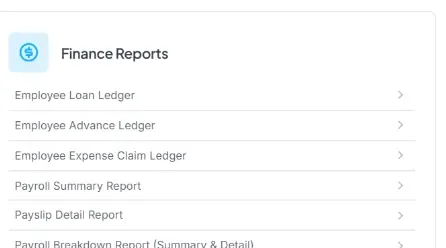
Loan Recovery deducts the EMI in each payroll cycle. Salary Advance tracks the short payment and the recovery from the next salaries. The outstanding balance is visible to HR and to the employee. The reports screen has an Employee Loan Ledger and an Employee Advance Ledger, next to the payroll summary.
Final settlement, on the Enterprise tier, includes outstanding loans. An employee can ask Rehbar AI what is still left on the loan. That assistant is described on AI HR software in Pakistan. Loans and salary advances are on the Growth plan and above. The rupee prices are on the pricing page, not restated here as a loan fee. GPS attendance and the rest of the Starter list are a different plan. Do not describe a loan module as included in every tier.
Mistakes that show up at audit or at exit
- Cash advances with no ledger. If the money left in an envelope, payroll cannot recover it and tax cannot see it.
- An instalment so large that net pay drops below the minimum wage for that month. Check the wage guide before you lock the EMI.
- Forgetting section 13(7) when a loan crosses Rs 1 million at no interest or at less than 10%.
- Waiving a balance in a meeting and never telling payroll. The waiver is salary in that year if section 13(9) applies.
FAQ
Can an employer deduct a loan instalment from salary in Pakistan?
Yes, where the wages law that covers the establishment allows a deduction for recovery of an advance. The Payment of Wages Act 1936, section 7(2)(f), permits deductions for recovery of advances or for adjustment of over-payments of wages. Get the employee's written consent and keep the repayment schedule. Sindh and Khyber Pakhtunkhwa have their own Payment of Wages Acts. Use the statute that names your workplace. This is not legal advice.
Is an interest-free loan from my employer taxable?
Only when the loan is interest-free, or below the benchmark, and it exceeds Rs 1 million. Section 13(7) of the Income Tax Ordinance 2001 then treats the benchmark profit, or the shortfall, as salary. A loan of Rs 1 million or less is outside that rule. The text switches the rule off for the whole loan at or under that amount. It does not say that only the excess is taxed. Take advice before you treat a larger loan as partly exempt.
What is the benchmark rate for employee loans?
Ten percent a year. Section 13(14)(a) set the benchmark at 5% for tax year 2003 and raised it by one percentage point a year, with a cap of 10%. The cap is the rate that applies now. On a reducing balance, use one-twelfth of that rate on the balance outstanding each month.
How much salary advance can be given under the Punjab Labour Code?
Once the Code is in force, section 18 allows an interest-free advance not exceeding three times the notified minimum wage for unskilled workers, recovered in instalments of not more than one-fifth of remuneration. Punjab's last notified unskilled minimum wage on this site is Rs 40,000, so the cap in that example is Rs 120,000. The Code has not been treated as commenced on this page. Read the Punjab Labour Code 2026 guide before you change a policy.
What happens to my loan if I resign?
The outstanding balance belongs in the final settlement, and the employer deducts only what the written agreement and the wages law allow. Agree in writing whether any balance can be recovered from gratuity. Do not assume that right exists because the person is leaving.
Sources
Keep the loan balance on the same record as the payslip
EMI, advance recovery and the ledger in one pay run. Request a 14-day trial.